


Nigeria plans to build its $26 billion gas pipeline to Morocco in stages, initially extending an existing network to Sierra Leone to generate revenue from gas sales before proceeding further north. The approach was outlined in a report published on Sunday, November 8, by business news outlet Zawya, citing remarks by Nigerian National Petroleum Company (NNPC) chief executive Bashir Bayo Ojulari.
Speaking five days earlier at the ADIPEC energy conference in Abu Dhabi, Ojulari also disclosed talks with potential investors, including the United Arab Emirates’ state-owned oil company ADNOC. Financing has yet to be secured for the pipeline, which is being developed jointly by Nigeria and Morocco.
Building on an existing pipeline
“We’re not starting fresh,” Ojulari said, explaining that Nigeria intends to use the existing West African Gas Pipeline (WAGP) as the starting point for the next phase of construction.
The 678-kilometre pipeline already carries gas from Nigeria to Ghana, with connections supplying Benin and Togo. Running largely offshore along the Gulf of Guinea, it provides an established network that Nigeria hopes to extend westwards.
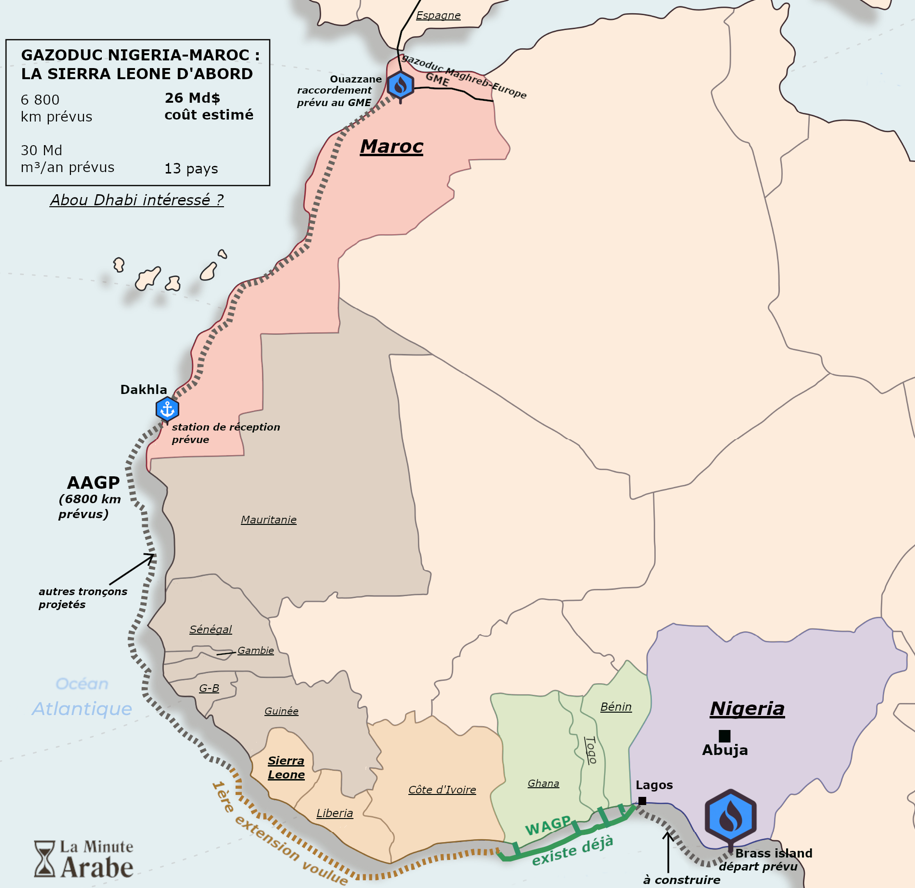
The first planned extension would reach Sierra Leone, passing through countries including Côte d’Ivoire and Liberia. Abuja intends to begin commercial gas deliveries along this section before committing to subsequent stages towards Morocco.
“Our intention is to extend [WAGP] to Sierra Leone, monetise that, and extend to the next one,” Ojulari said.
The phased approach would allow the project’s backers to generate revenue before completing the entire pipeline, while demonstrating the commercial viability of the initial extensions to prospective investors.
Ojulari said further announcements were expected in 2027 but gave no firm timetable for construction. NNPC currently holds a 24.9% stake in WAGP, one of the main gas transportation networks linking countries along the Gulf of Guinea.
A $26 billion project still seeking funding
Also known as the African Atlantic Gas Pipeline (AAGP), the Nigeria–Morocco project is being developed by NNPC and Morocco’s National Office of Hydrocarbons and Mines (ONHYM).
The planned pipeline would stretch approximately 6,800 kilometres along Africa’s Atlantic coast, including around 5,100 kilometres offshore, with a capacity of up to 30 billion cubic metres of natural gas annually.
Half of that capacity, or 15 billion cubic metres a year, is intended for Morocco and potentially European markets through a connection to the existing Maghreb–Europe Gas Pipeline linking Morocco to Spain.
The project is also designed to supply countries along its route, with planned connections to landlocked Sahel states including Mali, Niger and Burkina Faso. Its backers say the infrastructure could expand access to electricity, support industrial development and create jobs across West Africa.
On July 19, member states of the Economic Community of West African States (ECOWAS) signed an intergovernmental agreement in Freetown, Sierra Leone, establishing a framework for the project’s development. Engineering design studies and route reconnaissance surveys have also been completed, according to NNPC and ONHYM.
Securing the necessary investment remains the main outstanding hurdle. NNPC has approached international energy companies, including ADNOC, although no Emirati financial commitment to the pipeline has been confirmed.
No final investment decision or firm construction start date has been announced. Extending the existing network to Sierra Leone is now the first commercial milestone outlined by Abuja in its effort to move the project forward.