

Algeria is in advanced talks with Russian companies over their potential involvement in the Trans-Saharan Gas Pipeline (TSGP), a project spanning more than 4,000 kilometres that would carry Nigerian natural gas to Europe through Niger and Algeria. The negotiations come as the European Union prepares to phase out Russian gas imports by autumn 2027.
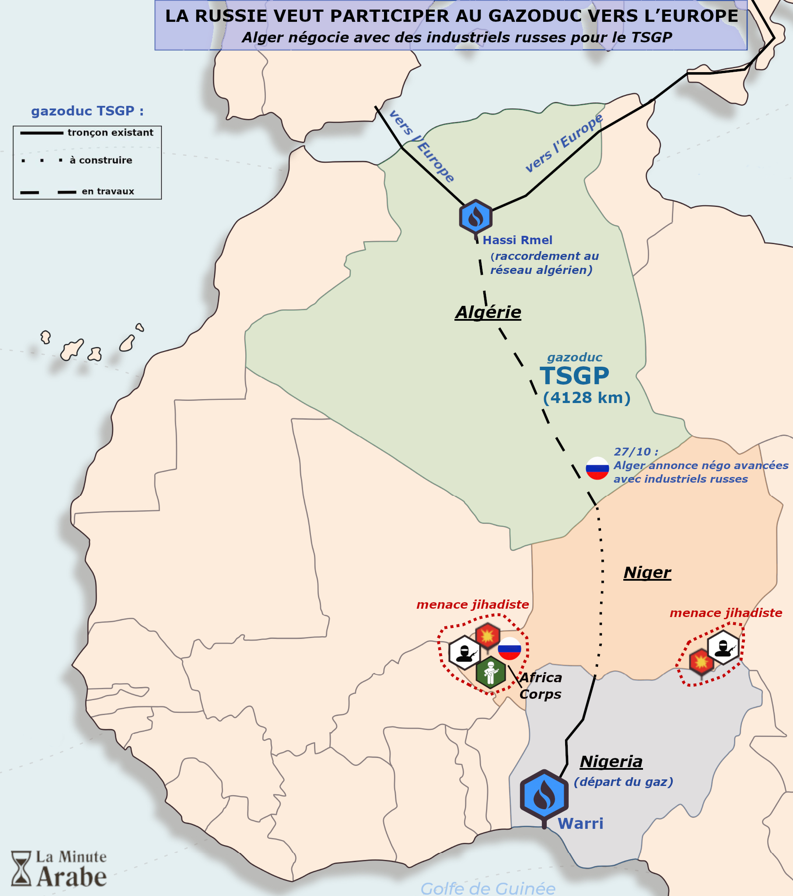
“We are going to finalise the contract,” Algerian Foreign Minister Ahmed Attaf said during a visit to Moscow on October 27. According to Algerian news outlet TSA Algérie, which reported his remarks on November 1, Algiers is finalising an agreement to bring Russian companies into the project. No company has been officially selected, and the scope of any future contracts remains unclear.
The pipeline is designed to transport between 20 billion and 30 billion cubic metres of natural gas annually from Nigeria to Algeria, where it could be exported to Europe through existing infrastructure. The project involves Algeria’s state-owned Sonatrach, the Nigerian National Petroleum Company (NNPC) and Niger’s state-owned petroleum company SONIDEP. It would cross three countries before reaching Algeria’s Hassi R’Mel gas hub.
US-sanctioned Russian pipe manufacturer emerges as potential partner
One company being considered is TMK, a Russian manufacturer of steel pipes and equipment used in oil and gas transportation, according to TSA Algérie.
TMK has already held industrial talks in Algeria. On June 23, a company delegation met representatives of the state-owned SNS holding company, alongside officials from steel groups ALSOLB and SIDER. Discussions covered pipe manufacturing, technology transfer and potential industrial cooperation. No TSGP-related contract was announced following the meeting.
TMK is, however, subject to US Treasury sanctions. If the company secured a contract, those restrictions could complicate international payments, banking arrangements and participation by certain project financiers.
The prospect of Russian involvement comes as the European Union moves towards ending its purchases of Russian gas. Regulations adopted in January 2026 provide for a ban on Russian pipeline gas imports under long-term contracts from September 30, 2027, with a possible extension until November 1.
The restrictions apply to the origin of imported gas and do not automatically prohibit the involvement of Russian companies in building transport infrastructure. Russian firms could therefore earn revenue from equipment supply, construction or technical service contracts linked to the TSGP without selling gas directly to the European Union. No agreement granting Russian companies a role in operating or maintaining the pipeline has been announced.
Construction begins in Algeria as security concerns persist in Niger
Sonatrach officially launched construction of the Algerian section on June 4 in Aoulef, in the southern province of Adrar. The route is expected to follow the Trans-Saharan Highway corridor towards Hassi R’Mel, where the pipeline would connect to Algeria’s national gas network and export infrastructure.
In Niger, preliminary topographical surveys along the proposed route began in October, according to statements by Algerian Hydrocarbons Minister Mohamed Arkab. Construction of the Nigerien section has yet to begin.
The pipeline would cross a country facing attacks by jihadist groups affiliated with Al-Qaeda and Islamic State. Niger also hosts Russian Africa Corps personnel, including in the capital, Niamey. According to Reuters, Russian troops helped retake an airbase occupied by mutinous Nigerien soldiers in late August.
Africa Corps has not been publicly assigned any role in protecting the TSGP. Algeria, meanwhile, announced a military deployment to Niger in late October to safeguard its economic and energy interests, without specifying whether its forces would help secure the planned pipeline.
The three partner countries still need to complete the studies and construction work required to bring the project into operation. No firm date has been announced for the start of Nigerian gas exports to Europe through the TSGP.