


The war against Iran has exposed a major vulnerability in Iraq’s economy: its heavy reliance on the Strait of Hormuz to ship oil to international markets. With economic losses estimated at $60 billion since the conflict began, Baghdad is stepping up efforts to safeguard its exports. On November 8, Foreign Minister Fuad Hussein announced an agreement with Washington aimed at facilitating the passage of Iraqi oil tankers through a maritime corridor along Oman’s coast. The arrangement could provide much-needed relief to Iraq’s economy, although its precise terms have yet to be clarified.
The stakes could hardly be higher for a country that derives nearly 90% of its government revenue from hydrocarbons. Before the US-Israeli strikes in late February, most Iraqi oil exports departed from terminals near Basra, in the Persian Gulf, bound primarily for Asian markets. Almost 90% of these shipments passed through the Strait of Hormuz. Restrictions on maritime traffic have severely disrupted this system, forcing several oil facilities to scale back operations as export outlets and storage capacity became increasingly constrained. Falling export revenues have also strained public finances, foreign currency reserves and the government’s ability to invest.
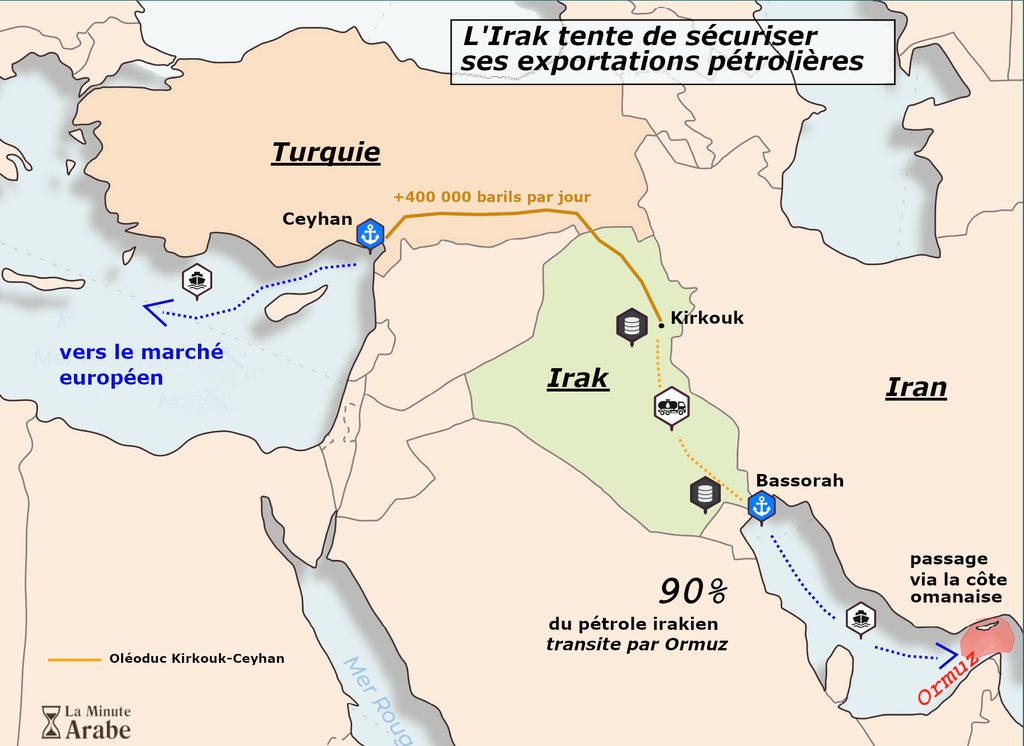
In response, Baghdad is developing an alternative route through northern Iraq. Since September, crude oil extracted from southern fields has been transported by tanker trucks to Kirkuk, where it enters a pipeline running to the Turkish export terminal of Ceyhan on the Mediterranean coast. This shift is supported in part by an agreement signed between Iraq and Turkey in August to maintain oil flows through the pipeline for another year.
Objective: Connect to the Mediterranean
The initial results are encouraging. According to Reuters, shipments through Ceyhan rose from 250,000 barrels per day in September to approximately 400,000 in October, an increase of 60% in just one month. Over the same period, Iraq’s total oil exports reached around 3.5 million barrels per day.
Yet the Turkish route remains only a partial alternative. Trucking crude north from southern Iraq involves additional costs, while existing infrastructure lacks the capacity to replace the volumes normally shipped through Hormuz.
The Iraqi government therefore intends to make export diversification a long-term priority. On November 5, Prime Minister Ali al-Zaidi met representatives of an international consortium to examine several proposed pipelines linking Iraq’s oilfields to ports on the Mediterranean and Red Seas. Potential routes include connections through Syria and Jordan, which would give Baghdad additional access to global markets without relying exclusively on the Persian Gulf.
These plans are part of a broader effort to expand domestic oil production capacity, notably through the development of new fields and the attraction of foreign investment. But increasing output alone will achieve little if export infrastructure remains exposed to regional crises.
For Baghdad, the challenge now goes well beyond restoring maritime traffic. The goal is to establish a sufficiently diversified oil export network to ensure that another closure of the Strait of Hormuz cannot, by itself, jeopardise the country’s economic stability.