


Lebanese President Joseph Aoun on Thursday, August 27, called on the United Arab Emirates to invest in Lebanon as he received a delegation of more than 80 business leaders and investors led by UAE Minister of Foreign Trade Thani Al Zeyoudi. The visit comes as Beirut seeks, among other projects, to reconnect the port of Tripoli in northern Lebanon to Syria’s railway network.
“We invite you to invest in Lebanon,” Aoun told the delegation. Al Zeyoudi, for his part, spoke of a role for Emirati companies in strengthening logistics links between Lebanon, the UAE and other international markets, according to the Lebanese presidency.
Lebanese broadcaster MTV reported on Wednesday that the UAE was showing interest in several infrastructure projects in the country, particularly in the north, citing the Tripoli Special Economic Zone as well as road and rail links with Syria.
Linking Tripoli to Homs
Two days before the meeting at Baabda Palace, the Lebanese and Syrian transport ministers met in Damascus and agreed to revive rail links between the two countries and set up a joint technical team.
Lebanese Transport Minister Fayez Rasamny said he wanted to reconnect the port of Tripoli to Syria’s railway network through Homs. The project could allow goods to move between the Mediterranean and Syria, with further links to Iraq and Gulf countries.
Lebanon had already launched a tender in May to study the rehabilitation of the railway line between Tripoli and the Syrian border.
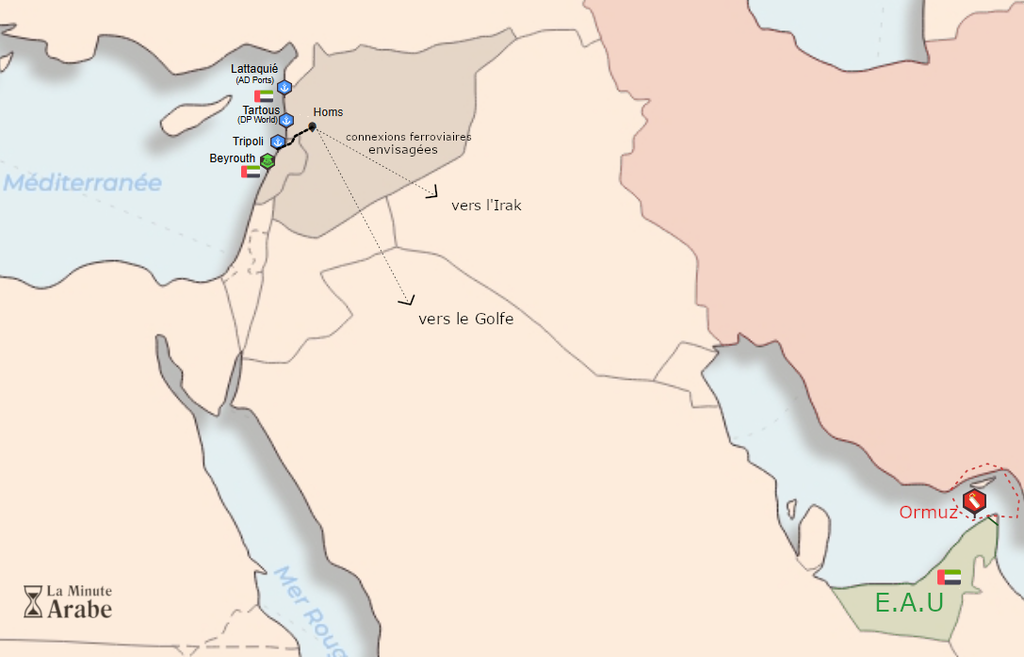
Emirati investment already under way in Syria
Just a few dozen kilometres farther north, Emirati companies have already invested in Syrian port infrastructure.
In July 2025, DP World signed a 30-year concession to develop and operate the port of Tartous, with $800 million in planned investment.
In Latakia, AD Ports Group acquired a 20% stake in the container terminal operated by CMA CGM for $22 million in November 2025.
Emirati capital is not limited to ports. In May 2026, Mohamed Alabbar, founder of property developer Emaar, said he was considering $5 billion to $7 billion in real estate and tourism projects along the Syrian coast.
Interest in overland links between the Gulf and the Mediterranean comes as shipping through the Strait of Hormuz remains heavily disrupted following the war with Iran.
“Security and investment are interconnected”
In Beirut, Lebanese officials also stressed the political conditions needed for investment to return.
Economy Minister Amer Bisat told the Emirati delegation that investors could not plan with confidence as long as weapons and decisions over war and peace were not under the sole authority of the state.
Abu Dhabi has explicitly backed the Lebanese state’s monopoly on arms and the disarmament of Hezbollah, the Iran-backed political and armed group that has refused to hand over its weapons to the authorities.
Aoun summed up the link with investment on Thursday. “Security and investment are interconnected,” he said.