

France and Morocco launched a call for expressions of interest in Rabat on 16 July to study an undersea electricity link between the two countries. It could carry up to 2,000 megawatts of solar and wind power generated in Morocco to southern France.
The project may appear surprising, as France exported more electricity than ever before in 2025, helped by the recovery in nuclear output and relatively subdued consumption.
The preferred plan includes new renewable energy plants in Morocco, storage facilities and two cables to France. Most of the electricity would be sent to France, with possible landing points in either the Var or Bouches-du-Rhône departments. However, the document also allows bidders to propose a two-way link if they can demonstrate its value and feasibility.
Why import electricity when you already export it?
France’s export record covers the whole of 2025, whereas the power grid must remain balanced at all times. Even as a large net exporter, France may need to import electricity during certain hours, when demand rises, solar output falls, the wind drops or a power plant is taken offline.
Power cables can move surplus electricity, help meet peaks in demand and provide emergency support after an outage. They also serve an economic purpose: it may be more profitable to export surplus power than to reduce production, or to import cheaper electricity than to run more expensive power plants in France, particularly gas-fired plants, according to Connaissance des Énergies.
As solar and wind power expand, with output varying according to the time of day and weather conditions, countries are increasingly relying on cross-border electricity exchanges rather than balancing their grids on their own.
These needs explain why most of the links shown on our map are designed to carry electricity in both directions.
Morocco is already connected to Spain by two bidirectional undersea cables across the Strait of Gibraltar, commissioned in 1997 and 2006. A third 700-megawatt link to Spain and a 1,000-megawatt connection with Portugal are also under consideration.
The Crete–Attica Electrical Interconnection, linking Crete with Attica, the region surrounding Athens, began operating in 2025. The Great Sea Interconnector is intended to connect Crete with Cyprus, with a possible extension to Israel. Lebanon is separately studying its own link with Cyprus.
ELMED is the planned connection between Tunisia and Sicily. Already approved and partly financed, it is scheduled to enter service in 2028. GREGY, meanwhile, is intended to connect Egypt and Greece, with electricity able to flow in both directions.
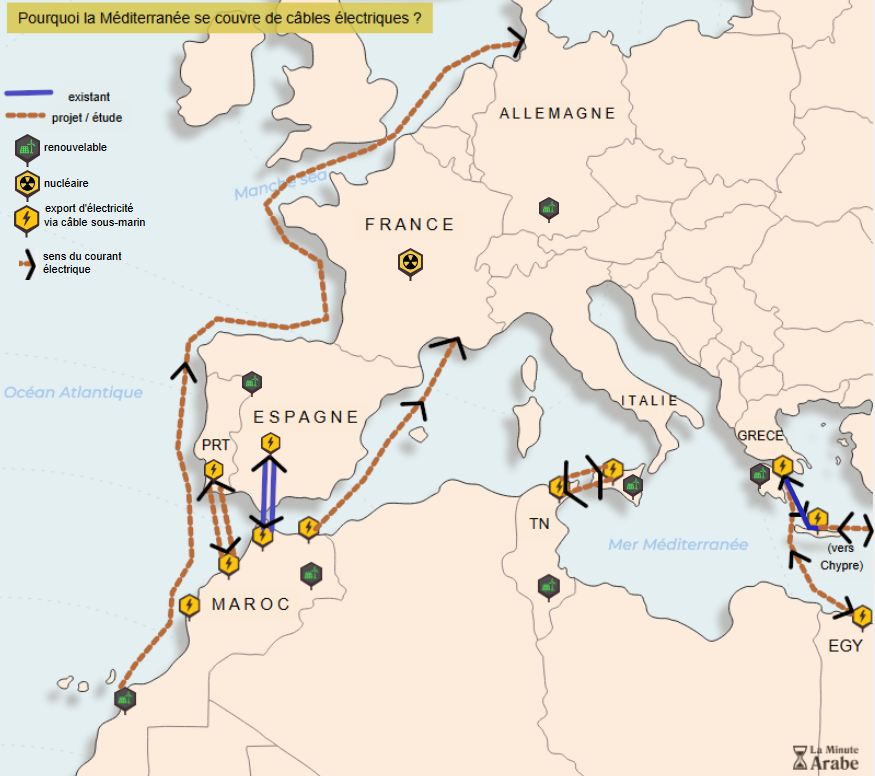
Projects at very different stages
Turning these projects into reality requires funding the cables, converter equipment at each end and the onshore grid connections.
High-voltage direct current technology, or HVDC, is better suited to long undersea links and helps limit transmission losses. However, longer routes make repairs more difficult, while cable installation can affect the seabed.
The Sila Atlantik project also shows how difficult such plans can be to deliver. The proposed link between Morocco and Germany would carry electricity from new Moroccan solar and wind farms to the German market.
At around 4,800 kilometres and an estimated cost of $30 billion, the project is being held up by several disagreements, Reuters reported on 22 July.
Rabat is seeking an agreement between the two governments and wants electricity to be able to flow from Germany to Morocco as well. This would give the kingdom an additional source of supply, but would increase the cost of a project originally designed to export Moroccan electricity to Germany, according to a German source quoted by Reuters.
The land required for the solar and wind farms has not yet been allocated either.
Ultimately, these cables are multiplying because the growth of solar and wind power is making electricity generation more variable, while grids need to move surplus power, quickly make up for shortages and take advantage of cheaper electricity available elsewhere at certain times.
Their usefulness does not, however, guarantee that they will be built. The cost of the cables and grid connections, the direction of power flows, government commitments, land availability and the price at which the electricity can be sold explain why some links are already operating or have secured financing, while the projects connecting Morocco with France and Germany still need to finalise their routes, financing arrangements and timetables.