


State-owned energy company ADNOC is advancing five gas production projects and one processing programme that could add or handle nearly 70 billion cubic metres of gas a year, equivalent to 120% of the UAE’s gas output in 2025, according to an analysis published by The National on August 3.
“ADNOC is accelerating its integrated gas strategy to further unlock the UAE’s vast gas resources and expand its global LNG platform,” chief executive Sultan Al Jaber said on July 21, following the approval of the Umm Shaif project.
The total assumes that all six projects are completed. It combines five sources of additional production with the Rich Gas Development programme, which will process more gas associated with oil production rather than extract an entirely new volume.
Why does the UAE rely on Qatar?
The UAE holds the world’s seventh-largest gas reserves, but much of its gas lies deep underground, offshore or contains high levels of hydrogen sulphide. This “sour gas” is toxic and corrosive, requiring expensive facilities and additional treatment.
For years, buying already-processed Qatari gas was therefore cheaper and quicker than developing some of the UAE’s more challenging domestic reserves.
Since 2007, the gas has crossed the Gulf through the Dolphin pipeline, running from Ras Laffan in Qatar to Taweelah near Abu Dhabi. The 364-kilometre subsea pipeline can carry around 20 billion cubic metres a year. Regular deliveries cover close to 30% of the UAE’s gas needs, while the current contract expires in 2032.
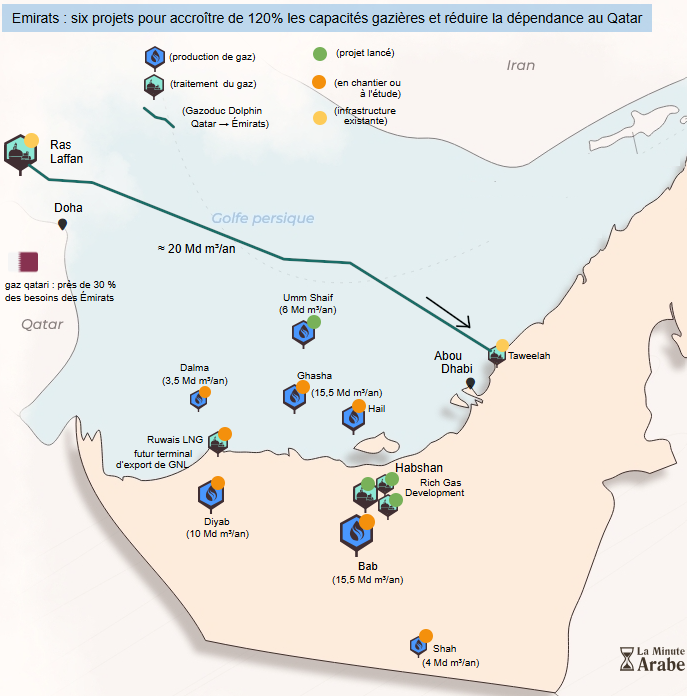
Six projects at different stages
Hail, Ghasha and Dalma, which are already under development, are expected to produce a combined 19 billion cubic metres a year. Umm Shaif, approved on July 21 with an investment of $6.2 billion, is due to produce more than 6 billion cubic metres a year from 2030.
France’s TotalEnergies holds a 20% stake in Umm Shaif and recently acquired 10% of Bab, which is targeting output of around 15.5 billion cubic metres a year.
Diyab is targeting around 10 billion cubic metres a year, while an expansion of Shah could add nearly 4 billion cubic metres. Both projects remain at an earlier stage.
The Rich Gas Development programme is not a new field. It will expand processing capacity at several facilities, including Habshan, allowing ADNOC to recover more gas associated with oil production.
Why now?
Demand is rising across industry, desalination and data centres. Some of the additional gas is also expected to supply Ruwais LNG, a 9.6-million-tonne-per-year export terminal due to come online in 2028.
Developing these technically challenging reserves is therefore becoming more attractive as Abu Dhabi seeks to reduce its reliance on Qatar and achieve gas self-sufficiency by 2030.