

A planned increase in Algerian gas production of up to 5.5 billion cubic metres a year by 2028, followed by a renewable hydrogen corridor to Germany: an analysis by Italian news agency Nova, reported on Tuesday, 28 July by Algerian daily Echorouk, connects the two strands of energy cooperation between Algiers and Rome.
The analysis does not announce a new agreement. It links investments already under way in gas production with the SoutH2 project, which is intended to connect North Africa with industrial markets in central Europe.
More than $8 billion invested in gas
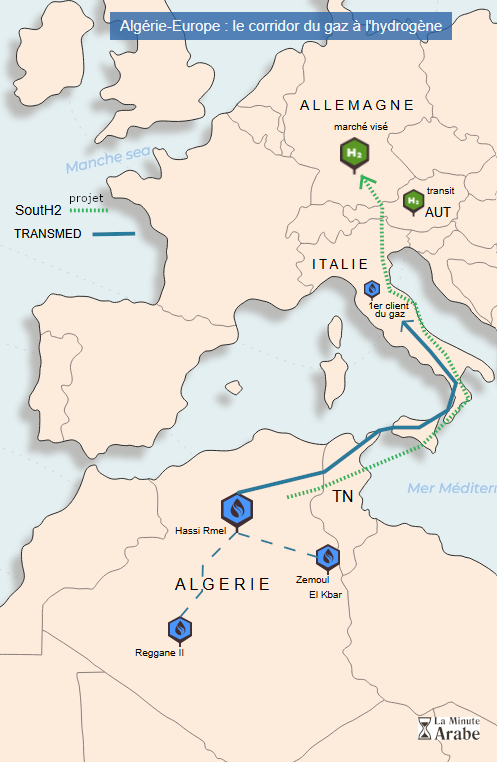
The Reggane II and Zemoul El Kbar projects, along with other Sonatrach and Eni developments, are expected to contribute to the increase in output. Planned investment exceeds $8 billion, according to the Italian group.
In July 2025, Eni and Sonatrach signed an exploration and development contract for Zemoul El Kbar, a 4,200-square-kilometre area located around 300 kilometres south-east of Hassi Messaoud. Reggane II had previously been awarded to Eni and Thailand’s PTTEP.
Some Algerian gas already reaches Italy through Transmed. The network links Hassi R’Mel to the Italian gas system through Tunisia, before crossing the Strait of Sicily between Cap Bon and Mazara del Vallo.
From gas to hydrogen
The future SoutH2 corridor would follow the same broad route between North Africa, Tunisia and Italy, before continuing north towards Austria and southern Germany.
Natural gas and hydrogen are, however, two different products. The first is extracted from underground reservoirs, while the second has to be produced. When generated by splitting water through electrolysis powered by solar or wind energy, hydrogen can help cut emissions in sectors that are difficult to electrify directly, including steelmaking, fertiliser production, refining and some forms of heavy transport.
Its environmental impact nevertheless depends on how it is produced. Hydrogen made from natural gas or coal remains highly carbon-intensive.
The main connection between the two energy sources therefore lies in the infrastructure. Some gas pipelines can be adapted to carry hydrogen after technical modifications.
Stretching 3,300 kilometres, SoutH2 is intended to connect North Africa to Italy, Austria and Germany. More than 65% of the route would rely on repurposed existing pipelines, supplemented by new sections. Commissioning is targeted for the early 2030s.