


Algerian President Abdelmadjid Tebboune has defended the Trans-Saharan Gas Pipeline linking Nigeria to Algeria through Niger and mocked a rival project running through a string of West African countries, an apparent reference to the Nigeria-Morocco African Atlantic Gas Pipeline.
“You build a project that passes through 14 countries, each country takes 5% (…) What will be left? Nothing but wind,” Tebboune said during his regular interview with representatives of the national media, broadcast on the evening of Saturday, October 3.
The Algerian president did not mention Morocco by name. However, the project he described matches the Nigeria-Morocco pipeline, which is planned to run along the West African Atlantic coast before reaching Morocco and connecting to gas infrastructure serving Europe.
Algiers promotes the shorter route
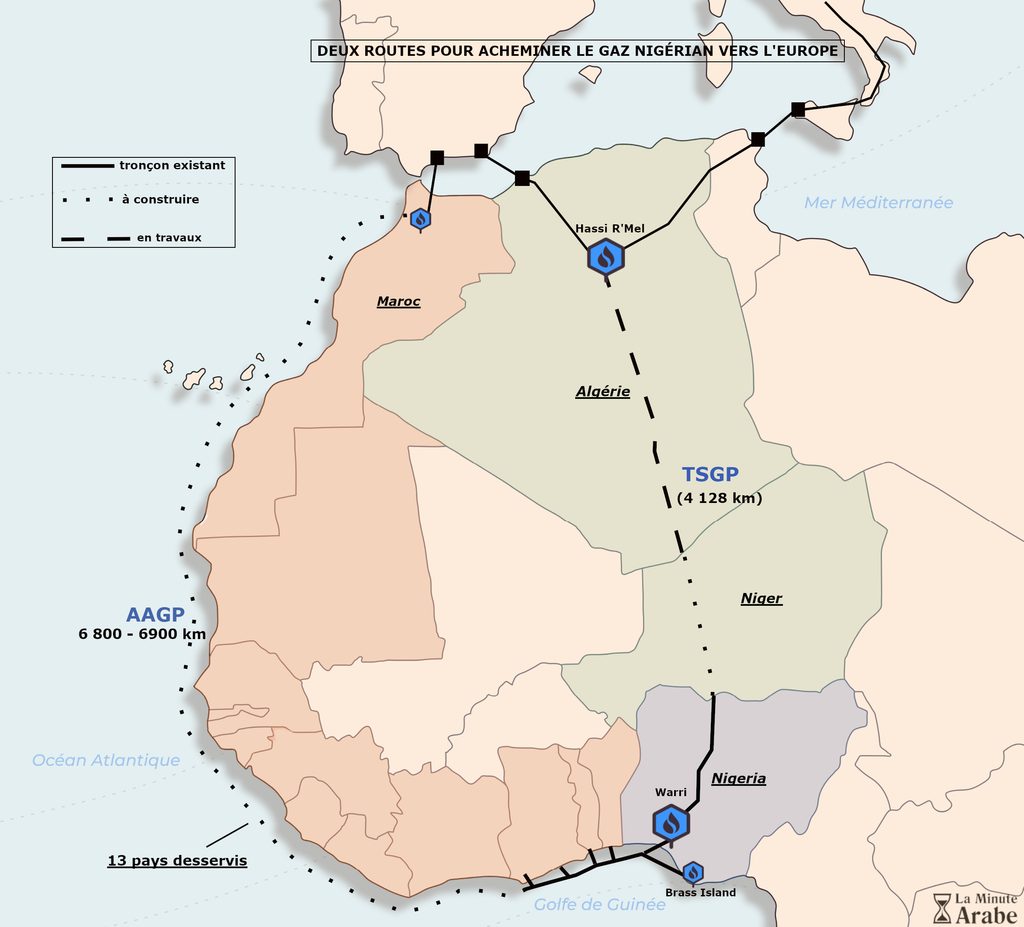
The Trans-Saharan Gas Pipeline (TSGP) is designed to carry Nigerian gas through Niger to Algeria, where it would connect at Hassi R’Mel to existing infrastructure used to transport gas towards the Mediterranean and Europe.
Sonatrach puts the route at about 4,128 km, including 1,037 km in Nigeria, 841 km in Niger and 2,310 km in Algeria, with a planned capacity of 30 billion cubic metres a year. Tebboune, for his part, referred on Saturday to a total length of around 4,500 km.
“We have our own gas. We are not bringing this gas in for use in Algeria. We are simply a transit country,” he said, arguing that Nigeria and Niger would be the main beneficiaries of the project.
Algeria officially launched work on June 4 in Aoulef, in Adrar province, on the remaining section of the TSGP to be built on its territory. The planned section will follow the Trans-Sahara corridor from the Nigerien border to Hassi R’Mel, where it will connect to Algeria’s existing gas network.
Tebboune also said Algerian teams would return to Niger to carry out fresh topographical surveys, identify the shortest viable route and take security conditions into account. Sonatrach had already sent a team to Niamey in March to gather technical data and review procedures for construction of the Nigerien section.
The project, led by Sonatrach, the Nigerian National Petroleum Company (NNPC) and Niger’s SONIDEP, has been under discussion for more than two decades. In February 2025, consultancy Penspen was commissioned to update its feasibility study.
Tebboune takes aim at the Atlantic route
The Algerian president contrasted the TSGP with another project that, according to him, would cross 14 countries, requiring gas to be shared and transit fees to be paid at each stage.
He claimed that each country could take 5% of the gas passing through its territory. That figure was presented by Tebboune; official documents on the Atlantic pipeline reviewed by La Minute Arabe do not set out a general rule allowing each country to take a 5% share.
The African Atlantic Gas Pipeline (AAGP), developed by Morocco and Nigeria, is planned to run for around 6,800 km, including roughly 5,100 km offshore, from Nigeria to Morocco. It is intended to serve 13 countries along the Atlantic coast and connect in northern Morocco to the Maghreb-Europe Gas Pipeline.
The project would start at Brass, in southern Nigeria. NNPC’s 2026 gas plan provides for a 540 km Nigerian section running to Badagry, with a capacity of 30 billion cubic metres a year, which is currently at the engineering-study stage.
Two projects at different stages
The Nigeria-Morocco project passed a political milestone in July 2026, when members of the Economic Community of West African States (ECOWAS) signed its intergovernmental agreement in Freetown. The agreement had been approved by ECOWAS heads of state in December 2024.
Detailed engineering studies have been completed, according to Morocco’s National Office of Hydrocarbons and Mines (ONHYM), while environmental and social studies are at an advanced stage. A project company is due to be established in Casablanca, alongside a governance body in Abuja, before financing is secured and a possible final investment decision is taken.
The TSGP, meanwhile, has an immediate advantage highlighted by Algiers: a significant share of the infrastructure it requires already exists in Nigeria and Algeria, while construction has begun on the remaining Algerian section.
The Nigerien section, however, still needs to be built and its precise route remains under technical review.
Both projects ultimately target the same resource, Nigerian gas, and envisage a similar capacity of around 30 billion cubic metres a year, but follow very different routes: one crosses Niger and Algeria directly towards the Mediterranean, while the other runs along the West African Atlantic coast before reaching Morocco and Europe.