

Algeria, Tunisia, Italy, Austria and Germany signed a ministerial declaration in Algiers on October 1 to advance the development of SoutH2, a planned 3,000 km corridor designed to carry up to 4 million tonnes of renewable hydrogen a year from Algeria to Europe.
The project would connect North Africa to the European market through Tunisia and Italy before continuing north to Austria and Germany. The hydrogen could supply heavy industry, fertilizer production and parts of the transport sector that are difficult to electrify directly.
Up to 10% of expected European demand in 2040
The European Union is seeking to expand renewable hydrogen use to replace part of the natural gas, coal and oil consumed in sectors where direct electrification remains difficult.
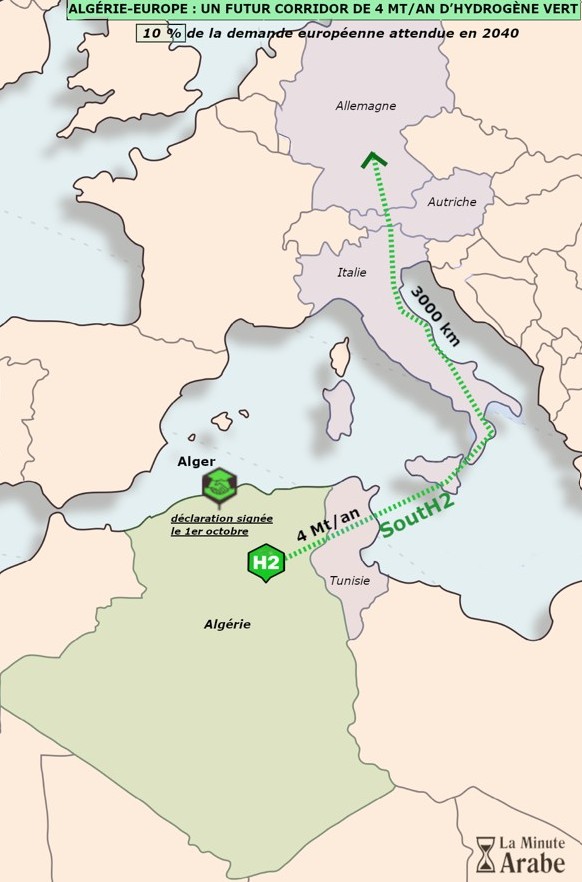
With a planned capacity of 4 million tonnes a year, SoutH2 could account for about 10% of Europe’s expected hydrogen demand in 2040.
The corridor would carry hydrogen from Algeria through Tunisia and Italy before reaching Austria and Germany. Parts of the existing gas network could be adapted for hydrogen transport alongside newly built infrastructure.
Political commitment, but no investment decision yet
The October 1 declaration does not amount to a final investment decision or the start of construction.
The five governments agreed to continue developing the project jointly, but several fundamental questions remain unresolved, including where the hydrogen would be produced in Algeria, how much the overall project would cost, how it would be financed and exactly how the fuel would be transported to European customers.
Initial results from the work now under way are expected in 2027.
Algeria enters the project with several advantages: abundant solar resources, energy infrastructure already connected to Europe and decades of experience exporting gas to the continent.
German companies scout opportunities in Algeria
The declaration came just days after a delegation of 10 German companies visited Algeria and Tunisia from September 21 to 25.
The companies explored potential projects involving hydrogen, electrolysers, storage, desalination and the conversion of existing gas pipelines.
The mission highlights the industrial interest developing alongside government talks on SoutH2, although the five countries still need to turn the proposed corridor into specific production projects, transport contracts and financing arrangements.