

“Two negations do not make a nation.”
Georges Naccache


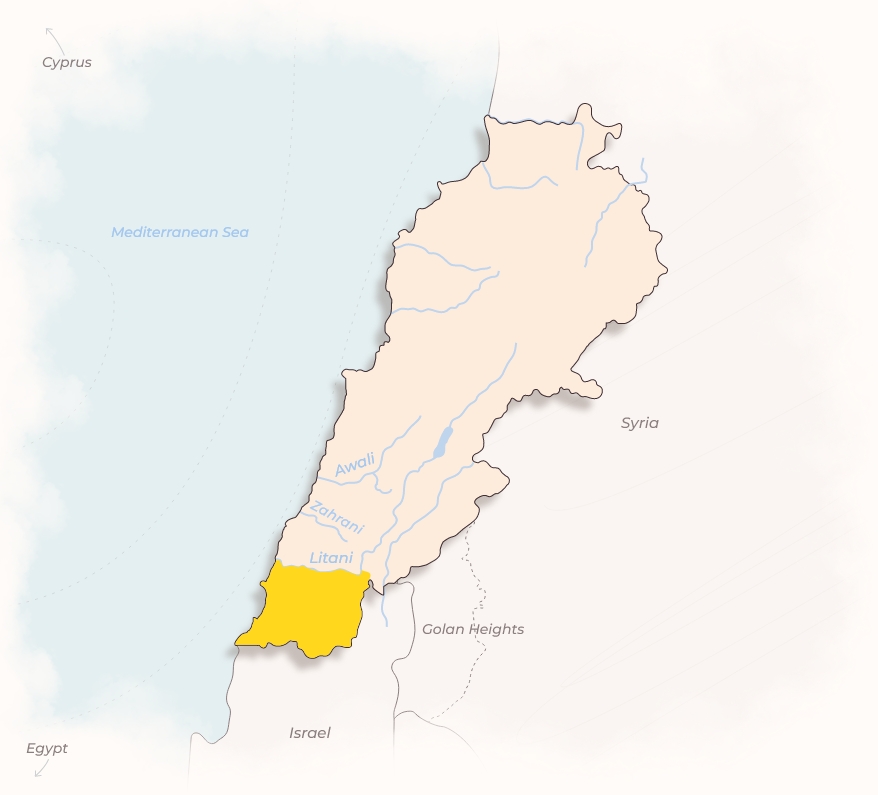


This map is interactive: click on the icons to access more information.

Population

Area

Currency

Religions
Sunni and Shia Islam
Various forms of Christianity

GDP (nominal)

Main exports

Main imports

Main customers

Main suppliers

Political system
After gaining independence from France in 1943, Lebanon adopted a confessional system that divided power among religious communities. The arrival of Palestinian refugees exacerbated tensions, which culminated in the civil war (1975–1990), involving Syria, Israel, and the Palestine Liberation Organization (PLO). The post-war period restored relative stability but cemented a fragmented system heavily influenced by external forces.
After the 2000s, the assassination of Prime Minister Rafik Hariri (2005), leading to the Syrian withdrawal, reshaped the political landscape, while Hezbollah, backed by Iran, established itself as a major political-military force largely beyond state control.
Since 2019, the country has been mired in a major economic crisis, exacerbated by the Beirut port explosion (2020) and the 2024 war between Hezbollah and Israel.
Since March 2026, Hezbollah, which refuses to disarm, has resumed hostilities against Israel at Iran’s request. In response, Israel has invaded southern Lebanon again, intensified its strikes and announced the expansion of a “buffer zone” up to the Litani River, underscoring the fragility of the Lebanese state. Under US auspices, Lebanon and Israel have begun direct negotiations, a first in more than three decades.
Elected in January 2025 after more than two years of presidential vacuum, former army chief Joseph Aoun is backed by the United States, France and Saudi Arabia. Initially cast as a compromise figure, he has pledged to restore state authority across Lebanon and enforce the state’s monopoly on weapons, in a country where Hezbollah still largely operates beyond institutional control.
Faced with the renewed war with Israel in March 2026, he defended direct negotiations as the only way to secure a lasting ceasefire, an Israeli withdrawal and the return of southern Lebanon to state control. The stance drew fierce criticism from Hezbollah, which rejects any direct dialogue with Israel. Aoun, in turn, warned against dragging Lebanon once again into a war serving foreign interests.
The first round of talks between the United...
Shortly after a new ceasefire between the Israeli...
Amnesty International accused Israel on Wednesday, June 17,...
Israel carried out new strikes in southern Lebanon...
The day after the announcement of an agreement...
Israel struck Beirut’s southern suburbs again on Sunday,...
La Minute Arabe est un média indépendant. Si vous souhaitez nous soutenir, votre contribution nous aide à améliorer nos contenus et à poursuivre ce travail d’information. En savoir plus
La Minute Arabe is an independent media outlet. If you want to contribute, your donation will help us improve our content and continue delivering clear, time-saving information every day. Read more