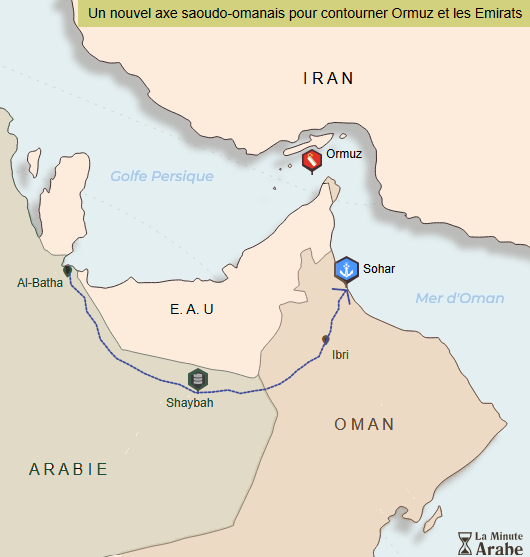
Saudi Arabia and Oman are set to develop a new land logistics corridor to increase freight and transit flows between the two countries, Al Arabiya reported on 12 August, six days after the Saudi Ministry of Transport announced the agreement.
“The agreement is intended to strengthen transit traffic, improve supply-chain efficiency and facilitate the movement of goods between the two countries,” the Saudi Ministry of Transport said on X on 6 August.
The agreement was signed between SPARK Logistics, a Saudi logistics company, and its Omani counterpart Arkan Logistics. The project is also expected to attract more transport operators and support the development of warehouses, distribution centres and services for trucks, according to Al Arabiya.
A direct road opened in 2021
The corridor does not involve the construction of a new road. It will use the direct land link opened between Saudi Arabia and Oman in 2021 across the desert.
On the Saudi side, the road stretches 564 kilometres from the Al-Batha-Haradh junction to the Omani border, passing through Shaybah. Its construction cost around 2 billion Saudi riyals ($533 million), according to Al Arabiya.
The route then joins Oman’s road network via Ibri before reaching Sohar, a port on the Gulf of Oman, south of the Strait of Hormuz. This gives Saudi freight another route to the Indian Ocean without relying on Emirati infrastructure.
Another route to the Indian Ocean
This option has gained importance in 2026 following severe disruption to maritime traffic through the Strait of Hormuz, which has prompted transport operators to expand overland connections between Omani ports and Saudi Arabia.
Riyadh is also investing in its own transport and logistics capacity as Saudi Arabia and the United Arab Emirates have competed for several years to attract trade flows, investment and the regional headquarters of major companies.
According to Al Arabiya, Saudi authorities aim to raise the transport and logistics sector’s contribution to GDP from around 6% to 10% and increase the sector’s non-oil revenues to around 45 billion riyals ($12 billion) by 2030.