

Protesters angered by power cuts entered the Mellitah oil and gas complex, around 80 kilometres west of Tripoli, on Tuesday, July 28, and halted operations, according to Arabic-language Libyan outlet Al-Wasat.
The shutdown reduced gas supplies to power plants, forcing several generation units offline. Libya’s state electricity company warned that the disruption could trigger a widespread blackout.
Gas flows restored after government forces intervene
The government of Abdulhamid Dbeibah ordered the Defence Ministry and the armed forces to retake control of the complex and reopen the pipelines supplying power stations.
The site was secured a few hours later. The National Oil Corporation then authorised operations to resume at Mellitah, as well as at the Wafa field and the offshore Sabratha platform. The power grid began to recover gradually once gas deliveries resumed.
The incident followed several days of protests over power cuts lasting nine to ten hours a day. Roads and public buildings were blocked in Tripoli and several western cities, while protest groups called for civil disobedience amid extreme heat and deteriorating public services.
A direct link to Sicily
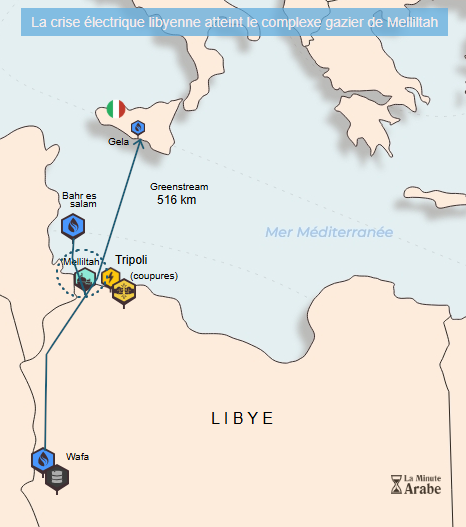
Mellitah processes gas from the onshore Wafa field and the offshore Bahr Essalam field. Some of the gas is supplied to Libyan power plants, while the rest is exported to Italy.
The complex is the starting point of Greenstream, a 516-kilometre subsea gas pipeline linking the Libyan coast to the terminal at Gela in Sicily, where it connects to Italy’s gas network. Its operator describes it as the longest subsea pipeline laid in the Mediterranean.
Mellitah is operated by a joint venture between Libya’s state-owned NOC and Italian energy group Eni. No prolonged disruption to exports to Italy was reported after the incident.