Iraq is stepping up efforts to strengthen its oil sector by simultaneously boosting production and diversifying its export routes. The strategy, led by Prime Minister Ali al-Zaidi’s government, also aims to attract greater foreign investment, particularly from the United States.
On July 5, Baghdad signed an agreement with U.S. energy services giant Halliburton to increase production at the Bin Omar and Sindibad oil fields in Basra province, according to Rudaw. Under the integrated management contract, the Basra Oil Company (BOC) will retain operational control of the fields, while Halliburton will provide expertise in reservoir modeling, infrastructure management, and production optimization. The goal is to raise output at Bin Omar to 150,000 barrels per day, while Sindibad is expected to produce between 80,000 and 100,000 barrels per day.
Seeking Alternatives to the Strait of Hormuz
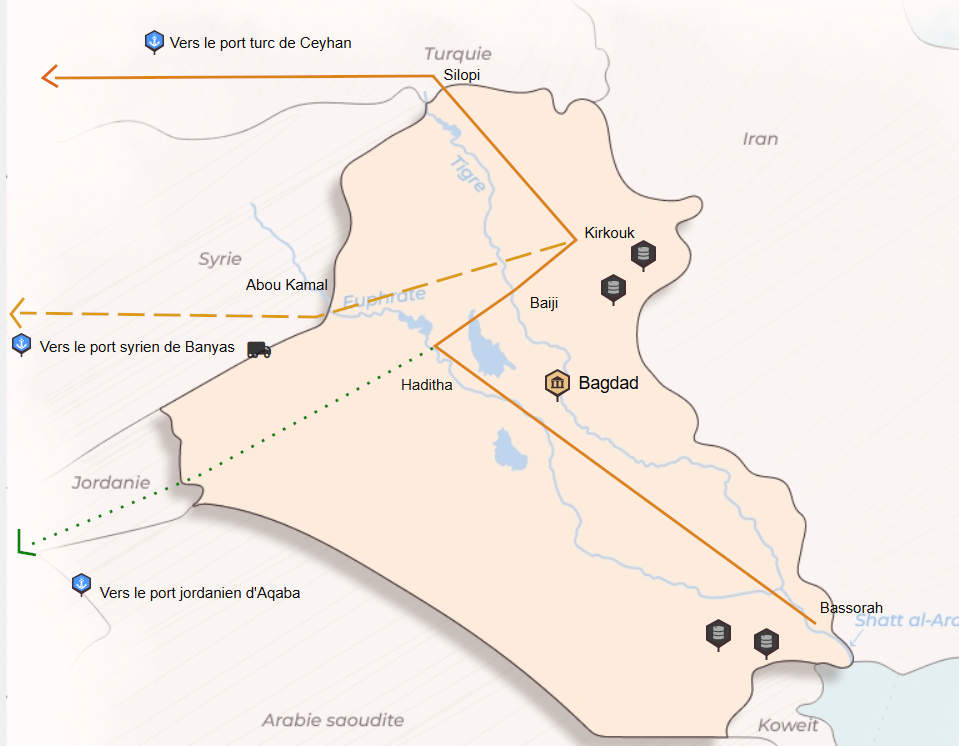
At the same time, Baghdad is reviving the long-delayed Basra-Aqaba pipeline project with Jordan. Announced on July 2 following a meeting between Prime Minister Ali al-Zaidi and a Jordanian ministerial delegation, the project is intended to deepen economic cooperation between the two countries while providing Iraq with an additional oil export route, according to Al-Alam al-Jadid.
The pipeline is designed to reduce Iraq’s reliance on its southern ports and Gulf shipping lanes, which remain vulnerable to regional tensions and potential disruptions in the Strait of Hormuz. Depending on the final route, the pipeline would stretch 900 to over 1,100 kilometers, with a planned capacity of 2.25 to 2.5 million barrels per day. The project is estimated to cost more than $4.6 billion.
Meanwhile, on July 4, Iraq’s Council of Ministers authorized the Basra Oil Company to sign a memorandum of understanding with a consortium comprising U.S. firms Capital TI and Chevron, along with Qatar’s UCC, to conduct feasibility studies for several strategic export pipeline projects, Reuters reported. The studies will focus on the Basra-Haditha-Kirkuk-Ceyhan and Basra-Haditha-Baniyas routes. Pending the construction of new infrastructure, Iraq continues to export part of its crude to Syria by tanker truck.
The agreement remains preliminary and does not create any binding financial obligations for Baghdad. The government also approved a consulting contract between the Basra Oil Company and U.S.-based KBR for the Basra-Haditha pipeline project to assess technical options before moving toward implementation.
These initiatives come as the 1973 Iraq-Turkey pipeline agreement, which has governed crude exports through the Turkish port of Ceyhan for more than five decades, is due to expire later this month. Ankara is seeking revised transit fees and greater investment in Iraq’s energy sector as part of a renewal. To prevent any disruption to oil exports, Iraq and Turkey are currently negotiating an interim protocol that would keep crude flowing through Ceyhan while a new long-term agreement is finalized.
Sources: Al-Alam al-Jadid / Rudaw / Reuters