


Iraq revived talks with Jordan and Egypt on Wednesday, August 5, over a planned oil pipeline linking Basra to the Jordanian port of Aqaba on the Red Sea, as Baghdad seeks to reduce its dependence on the Strait of Hormuz, Iraqi Kurdish outlet Rudaw reported, citing Iraq’s Foreign Ministry.
Iraqi Foreign Minister Fuad Hussein discussed with his Jordanian counterpart Ayman Safadi the “project to extend an oil pipeline from Basra to the port of Aqaba,” according to the ministry. The project was also raised in talks with Egyptian Foreign Minister Badr Abdelatty focused in part on energy cooperation.
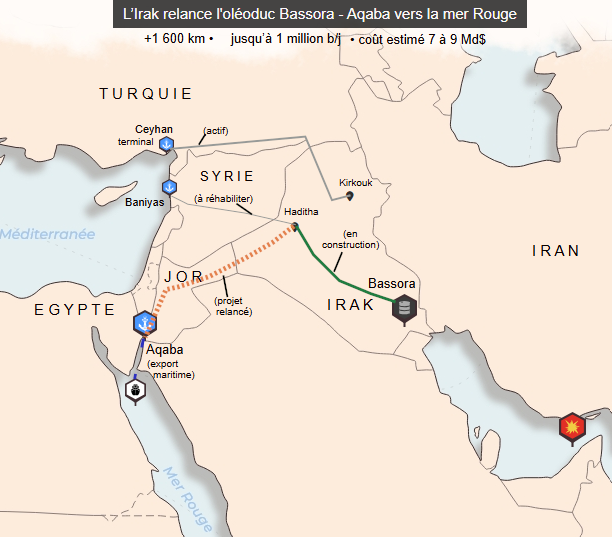
Stretching more than 1,600 kilometres, the planned pipeline could carry up to one million barrels of oil per day to Aqaba, at an estimated cost of $7 billion to $9 billion. Jordan would use around 150,000 barrels per day for domestic needs, while the remainder could be shipped from the Red Sea to international markets. Rudaw said some of the crude could also be delivered to Egyptian refineries.
Hormuz disruptions revive long-standing project
The project, discussed for decades, has gained fresh momentum amid disruptions in the Strait of Hormuz. At the height of the blockade, Iraqi oil production fell from 4.14 million to 1.49 million barrels per day, according to Rudaw.
Baghdad has meanwhile begun implementing the Basra-Haditha pipeline, which is expected to serve as the backbone for several overland export routes. Iraq’s Oil Ministry says the pipeline will have a capacity of 2.5 million barrels per day and could eventually feed routes towards Aqaba in Jordan, Baniyas in Syria and Ceyhan in Turkey.
The three corridors are at very different stages. The Haditha-Aqaba section has yet to be built, while Baghdad is studying the rehabilitation of the route to Baniyas. The pipeline to Ceyhan, by contrast, is already operational: Iraq and Turkey signed a new agreement on August 1 aimed at increasing exports through the route to at least 750,000 barrels per day.
For Iraq’s Oil Ministry, the projects are intended to give the country greater flexibility in the event of renewed disruption in Hormuz, through which the vast majority of Iraqi oil exports passed before the war.