
Oil exports from Jask, the terminal Iran built on the Gulf of Oman to bypass the Strait of Hormuz, fell to zero in the first week of September, according to Kpler data cited by Asharq Bloomberg on September 7.
Loadings had reached 129,000 barrels per day in March, before falling to 76,000 b/d in July and 33,000 b/d in August. “Jask was originally built to bypass Hormuz,” said Homayoun Falakshahi, head of crude oil analysis at Kpler.
A Route Around Hormuz
Jask lies east of the strait, unlike Kharg, which sits inside the Gulf and accounted for more than 90% of Iran’s oil exports before the war.
The terminal can theoretically load 1 million barrels per day, but its capacity is constrained by the pipeline feeding it from Goureh, which can carry around 500,000 b/d.
Iran used Jask during tensions in 2024, again during the 12-day war in June 2025, and after the current conflict began in late February.
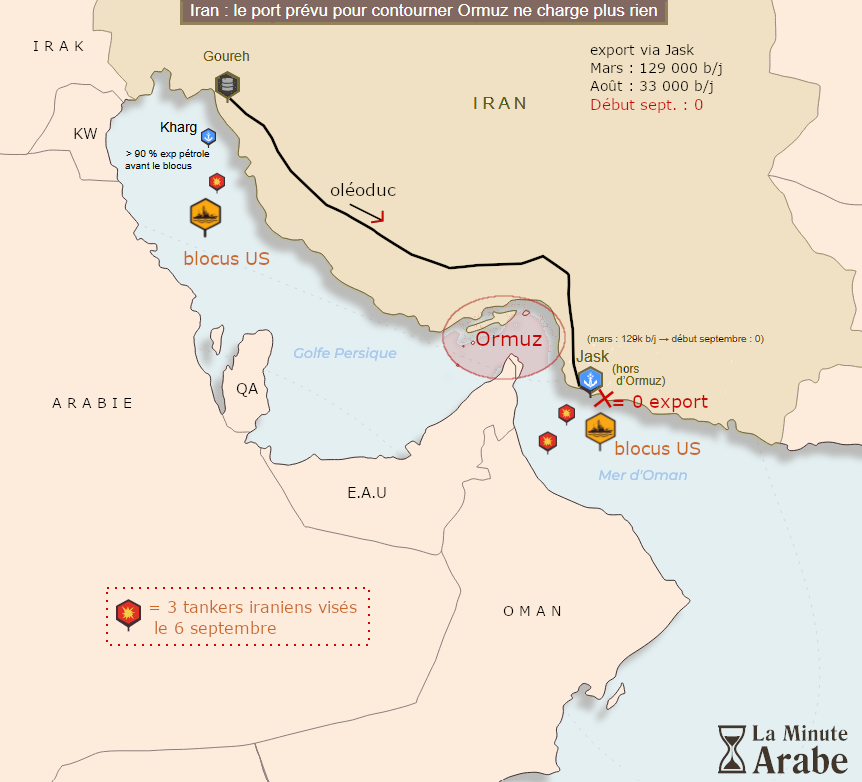
With no loadings detected at either Kharg or Jask, Iranian oil exports are now “virtually at zero,” according to Kpler. The absence of tracked flows does not, however, rule out shipments that may be evading vessel-monitoring systems.
US Strikes Iranian Tankers
The collapse in exports comes as the United States has enforced a maritime blockade on Iran since July.
On September 5, US Central Command said it had struck three Iranian oil tankers after missiles were fired at two US Navy warships. The Stark 1 was targeted near Jask, the Downy off Kharg and the Kylo in the Gulf of Oman.
Tehran hardened its rhetoric on September 8. Mohsen Rezaei, secretary of Iran’s Supreme National Security Council, threatened to establish a regulated maritime zone in response to the US blockade, with penalties for ships entering it.