


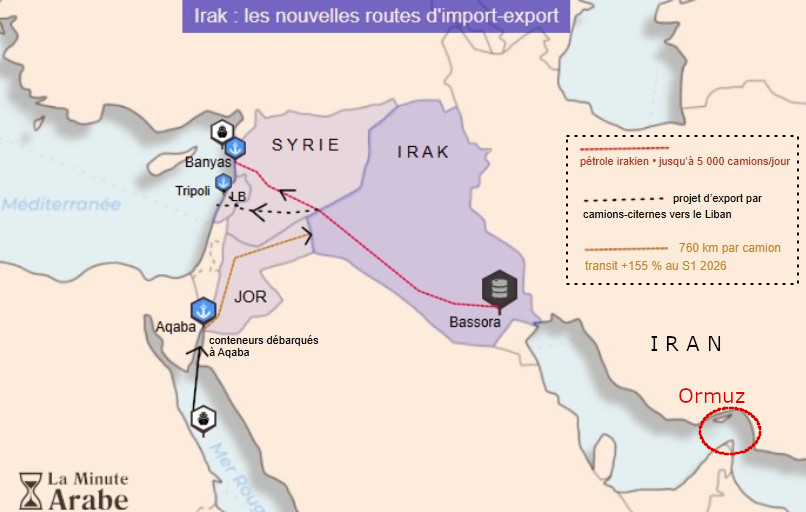
Donald Trump on Thursday, September 3, welcomed the development of new overland routes linking Iraq to the Mediterranean, as up to 5,000 trucks carrying Iraqi oil travel each day to the Syrian port of Baniyas, according to the Washington Post.
“This is GREAT!” the US president wrote on Truth Social as he shared the newspaper’s investigation into corridors being used to reduce reliance on the Strait of Hormuz. Trucks began in April carrying oil from refineries in southern Iraq to Baniyas, on Syria’s Mediterranean coast.
The Washington Post met an Iraqi driver in Al-Qaryatayn, in the Syrian desert, who makes the round trip between Basra and Baniyas in ten days. Ahmad Qubbaji, deputy head of the Syrian Petroleum Corporation, said 5,000 trucks arrive from Iraq every day without major security incidents.
A Basra-Baniyas Pipeline
Washington is also backing a pipeline project between Basra and Baniyas along the same corridor used by the truck convoys.
The project, led by a consortium expected to include US oil major Chevron, France’s TotalEnergies and Syrian and Qatari investors, could carry up to 2 million barrels per day. The Washington Post puts its cost at $5.7 billion for a route of roughly 1,600 kilometres.
A final contract is expected in September, according to Ahmad Qubbaji. Construction would take at least two and a half years. Part of the route would cross western Iraq, where the presence of armed groups nevertheless poses a security risk to the future infrastructure.
The Trump administration announced its support for the project in July. US envoy Tom Barrack said at the time that such a link could make the Strait of Hormuz “a secondary consideration” for exporters in the region.
Goods Are Also Moving Through Aqaba
The shift is also affecting Iraqi imports, but in the opposite direction.
Containers bound for Iraq are now arriving at the Jordanian port of Aqaba, on the Red Sea, before being trucked around 760 kilometres to the Iraqi border.
Transit cargo volumes at Aqaba Container Terminal rose 155.1% in the first half of 2026 compared with the same period in 2025. According to Reuters, the increase was driven largely by Iraq-bound cargo.
Before the war, a large share of these imports arrived through ports in southern Iraq, reached from the Indian Ocean via the Strait of Hormuz. Disruptions to maritime traffic have pushed carriers and importers to make greater use of Jordan.
Tripoli Also Under Consideration
Lebanon, meanwhile, is negotiating with Baghdad over another Mediterranean outlet for Iraqi oil.
The plan would move crude from the Basra oil fields to the oil facilities in Tripoli, northern Lebanon, via Syria. Lebanese Prime Minister Nawaf Salam raised the proposed route after a visit to Iraq in July.
MTV reported in early August that initial shipments would be carried by tanker trucks, before the possible restoration of a permanent oil link. No commercial deliveries to Tripoli have yet been announced.
A Lebanese committee was still working on the project on August 20, including logistics, tanker traffic management, operations and financing.
These routes are developing as traffic through the Strait of Hormuz remains far below pre-war levels. On Monday, only five vessels transited the strait, according to Kpler data cited by Reuters.