


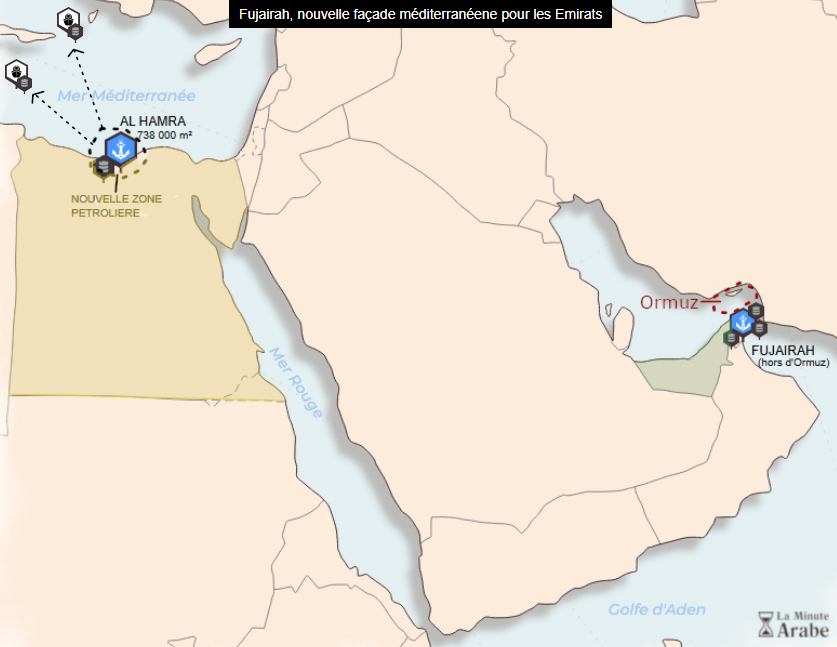
Egypt and the Emirate of Fujairah completed the establishment of Fujairah Alamein Oil and Gas last week, a company tasked with developing and operating a nearly 738,000-square-metre petroleum free zone at Al Hamra on the Mediterranean coast, Egypt’s Ministry of Petroleum said.
The company’s creation marks “the transition from agreements to actual implementation,” Egyptian Petroleum Minister Karim Badawi said, adding that a detailed timetable should now be drawn up for the different phases of the project.
The zone, approved by the government under Decree No. 65 of 2026, will be dedicated to the storage and trading of crude oil and petroleum products. Its free-zone status is intended to facilitate storage, trading and re-export operations.
Fujairah’s model comes to the Mediterranean
The project draws directly on the system developed in Fujairah on the Gulf of Oman. The agreement with Egypt provides for the Fujairah Oil Industry Zone model to be replicated at Al Hamra Petroleum Port, covering oil storage, trading and marine services.
Mohammed Saeed Al Dhanhani, a senior Fujairah official, had said the emirate wanted to “build on the successes already achieved” in oil storage, trading and ship bunkering.
Part of Fujairah’s business comes from handling cargoes that can be stored, traded and then re-exported, including on behalf of third parties. Al Hamra allows the emirate to develop the same business directly on the Mediterranean, closer to European markets.
Cargoes received in Egypt will be able to be stored, resold and re-exported to other Mediterranean ports. The authorities have not, however, announced any reserved volumes or specific commercial destinations.
Al Hamra doubles its storage capacity
The project will build on an existing oil port operated by Egypt’s state-owned WEPCO.
Egypt is currently expanding Al Hamra’s crude storage capacity from 2.8 million to 5.3 million barrels. WEPCO expects around 88 million barrels of throughput in 2026/27 through the port’s marine facilities and pipelines, equivalent to roughly 240,000 barrels per day.
Third-party storage capacity is also set to increase from 150,000 to 300,000 cubic metres, while a new petroleum products storage area is expected to provide 130,000 tonnes of capacity.
Cooperation with Fujairah has already produced commercial activity. A first tanker was received at Al Hamra under the agreement in November 2024, before the two sides signed a crude storage contract and an agreement for the supply of petroleum products to Egypt’s state-owned EGPC.
A second maritime foothold for Fujairah
Al Hamra is not intended to replace Fujairah’s own port. The emirate remains one of the UAE’s main oil export outlets on the Gulf of Oman, outside the Strait of Hormuz.
Abu Dhabi is also strengthening that route. ADNOC is building a second pipeline to Fujairah, due to enter service in 2027 and double its export capacity through the emirate.
The new Egyptian operation will give Fujairah’s oil storage and trading business access to a second market, this time on the Mediterranean and closer to Europe.
No opening date has yet been announced for the Al Hamra zone. Egypt’s Petroleum Ministry has asked the project teams to draw up an implementation timetable.