


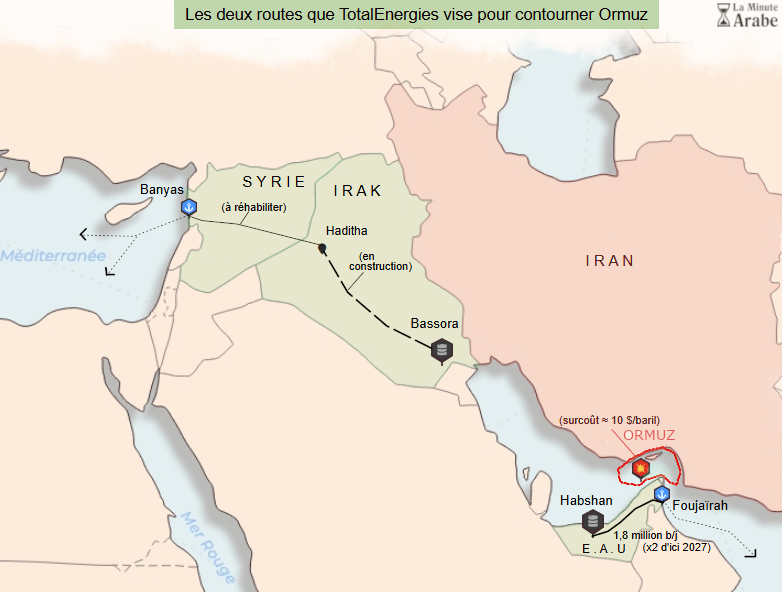
TotalEnergies plans to invest in two routes designed to bypass the Strait of Hormuz, one linking Abu Dhabi to Fujairah in the United Arab Emirates and the other connecting Iraq to Syria’s Mediterranean coast.
“We will become partners of the pipeline moving from Baghdad to Syria, but I will also invest in Abu Dhabi, in doubling the Fujairah pipeline,” TotalEnergies CEO Patrick Pouyanné said on Monday, August 24, at an energy conference in Norway, according to Emirati outlet Erem Business, citing Reuters.
The financial terms and the stakes TotalEnergies could take in the two projects have not been disclosed.
One route to Fujairah, another to the Mediterranean
In the UAE, the Habshan-Fujairah pipeline can already carry up to 1.8 million barrels of crude per day from Abu Dhabi to the port of Fujairah on the Gulf of Oman, outside the Strait of Hormuz.
ADNOC has been building a second pipeline since 2025 to double export capacity through Fujairah. The Emirati group said in May that construction was 50% complete, with commissioning scheduled for 2027.
The second route mentioned by Pouyanné runs through Iraq and Syria. Iraq is building a pipeline from Basra to Haditha, in the west of the country, with a planned capacity of 2.25 million barrels per day.
Baghdad and Damascus also signed a memorandum in July to restore a link between Haditha and the Syrian port of Baniyas on the Mediterranean. The planned capacity is 2 million barrels per day. The project is currently being studied with an international consortium that includes US oil major Chevron.
TotalEnergies’ involvement would therefore add the French group to a project already being pursued by the Iraqi and Syrian authorities alongside several international companies.
Hormuz remains profitable for TotalEnergies
The company is nevertheless continuing to move crude through the Strait of Hormuz despite the risks linked to the war.
Pouyanné said TotalEnergies was today “probably the largest trader of oil from Iraq or from Qatar,” according to Erem Business. He said a round trip through Hormuz by a very large crude carrier currently costs around $20 million, equivalent to an additional $10 per barrel for a tanker carrying 2 million barrels.
That extra cost is still being offset by the discounts offered by producers seeking to sell their crude.
“Crude oil is sold to you at $50, $60 per barrel, not the Brent price, because the producers are desperate to push their oil into the market,” Pouyanné said.
Brent crude was trading above $90 a barrel on Monday.
Before the war, roughly one-fifth of global oil and LNG supplies passed through the strait. TotalEnergies now plans to continue using Hormuz when the economics remain attractive while investing in alternative export routes that would reduce its reliance on the chokepoint.