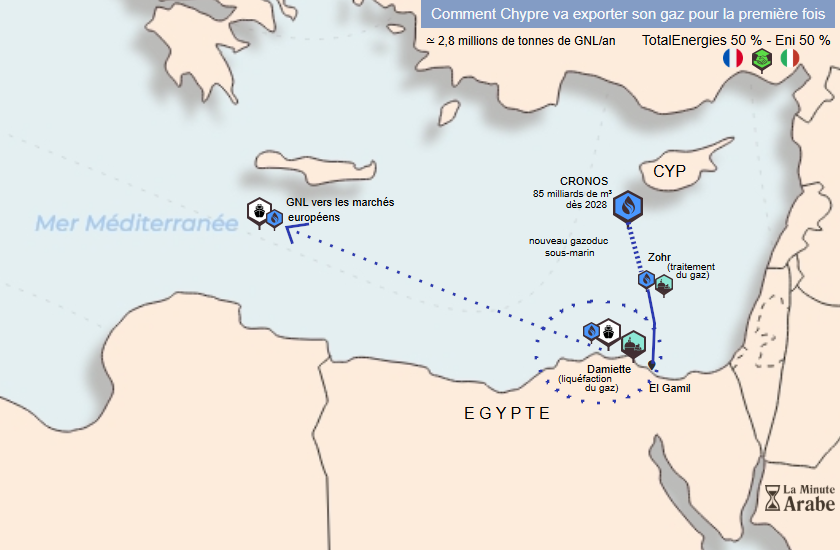
Cyprus is expected to produce and export natural gas for the first time from 2028, following TotalEnergies and Eni’s decision to develop Cronos, the country’s first gas field set to enter production.
The island made its first gas discovery, Aphrodite, in 2011, but has yet to market any of the volumes found in its waters. Cronos is expected to take Cyprus from gas exploration to commercial production.
A field containing 85 billion cubic metres of gas
TotalEnergies holds a 50% stake in the project. The remaining 50% is owned by Italy’s Eni, which will operate the field. The two partners have taken the final investment decision, the French group announced on Tuesday, 28 July.
Discovered in 2022 around 185 kilometres southwest of the Cypriot coast, Cronos contains more than 3 trillion cubic feet of gas, equivalent to roughly 85 billion cubic metres.
The field will be developed through four subsea wells. Production is expected to reach 500 million cubic feet per day, equivalent to around 2.8 million tonnes of liquefied natural gas annually. TotalEnergies will market half of these volumes.
At full capacity, this output could generate around $1 billion in annual LNG sales, based on a price of $7 per million British thermal units. This estimate does not represent Cyprus’s net revenues.
Gas to be exported through Egypt
The gas will be transported by subsea pipeline to Egypt, processed through facilities linked to the Zohr field and then liquefied at the Damietta LNG terminal before being exported, mainly to Europe.
This will allow Cyprus to sell its gas without building its own liquefaction plant, by using infrastructure already available in Egypt.
Egyptian Petroleum Minister Karim Badawi described the decision as a “milestone” in cooperation between the two countries, according to Egyptian news outlet Youm7. Cronos will be the first project to connect a Cypriot gas field directly to Egyptian gas infrastructure, he added.
Neither company has disclosed the size of the investment. An analysis published by the Cyprus Economic Society estimates total upstream development costs at between $5 billion and $6.4 billion, depending on assumptions regarding recoverable volumes.