


The conflict in the Middle East has entered a new maritime phase. Overnight on 22 July, Yemen’s Iran-backed Houthi movement claimed responsibility for attacks on two Saudi oil tankers in the Red Sea, saying the vessels had “violated the blockade” it recently declared against Saudi ports.
The escalation comes as the United States continues its twelfth consecutive day of strikes against Iran.
The Houthis identified the targeted vessels as the Encelia and the Layla. Saudi authorities confirmed that the Encelia, owned by a Saudi company, was attacked while sailing near the strategic Bab el-Mandeb Strait. Riyadh said that no crew members were injured.
Since announcing their maritime blockade, the Houthis have repeatedly broadcast radio warnings to vessels transiting the area, threatening to attack ships that ignored their restrictions. According to AFP, at least nine vessels have already turned back in the Red Sea or near the Bab el-Mandeb Strait to avoid potential attacks.
Saudi ports increasingly in the Houthis’ crosshairs
The stakes are particularly high because Bab el-Mandeb has effectively become Saudi Arabia’s last remaining maritime outlet for crude exports to Asia. Since the closure of the Strait of Hormuz following the outbreak of the U.S.-Israeli conflict with Iran in late February, more than 70% of Saudi oil exports have been rerouted via the East-West Pipeline (Petroline) to the Red Sea export terminal of Yanbu. According to Kpler and Signal Ocean data cited by Al Jazeera, shipments through Yanbu have surged to 4 million barrels per day, up from 973,000 barrels per day a year earlier.
That alternative export route is now coming under pressure as well. According to Kpler data cited by The National on 20 July, crude shipments through Bab el-Mandeb have fallen by 36% in just two weeks, with Saudi Red Sea exports dropping from 9.5 million to 6.1 million barrels per week between late June and mid-July.
As Andreas Krieg, a security expert at King’s College London, told The National: “A simultaneous closure of Hormuz and Bab el-Mandeb would effectively place Saudi Arabia under strategic siege.”
The implications extend well beyond Saudi Arabia. At just 32 kilometers wide, the Bab el-Mandeb Strait handles roughly 12% of global maritime trade. Around 4.1 million barrels per day of crude oil and refined petroleum products transited the waterway in 2024, down from more than 9 million barrels per day before the Houthi attacks began in late 2023.
According to Al Jazeera, the simultaneous closure of both Hormuz and Bab el-Mandeb could disrupt up to one-quarter of global oil and gas supplies. Meanwhile, disruptions to Red Sea shipping between 2023 and 2025 are estimated to have cost the global economy around $20 billion annually, according to estimates cited by CNN Arabic.
While Yanbu remains the primary focus, several other Saudi Red Sea ports could also face heightened risks if the conflict escalates. Jeddah, the Kingdom’s largest port, handles more than 65% of Saudi Arabia’s cargo traffic and serves as its main container hub, according to Saudipedia. Further south, Jazan, located roughly 190 nautical miles from Bab el-Mandeb, is geographically the closest major Saudi port and therefore the most immediately exposed. To the north, the ports of Duba, near NEOM, and King Abdullah Port in Rabigh complete a Red Sea coastline that could become increasingly vulnerable should Houthi operations expand beyond oil tankers.
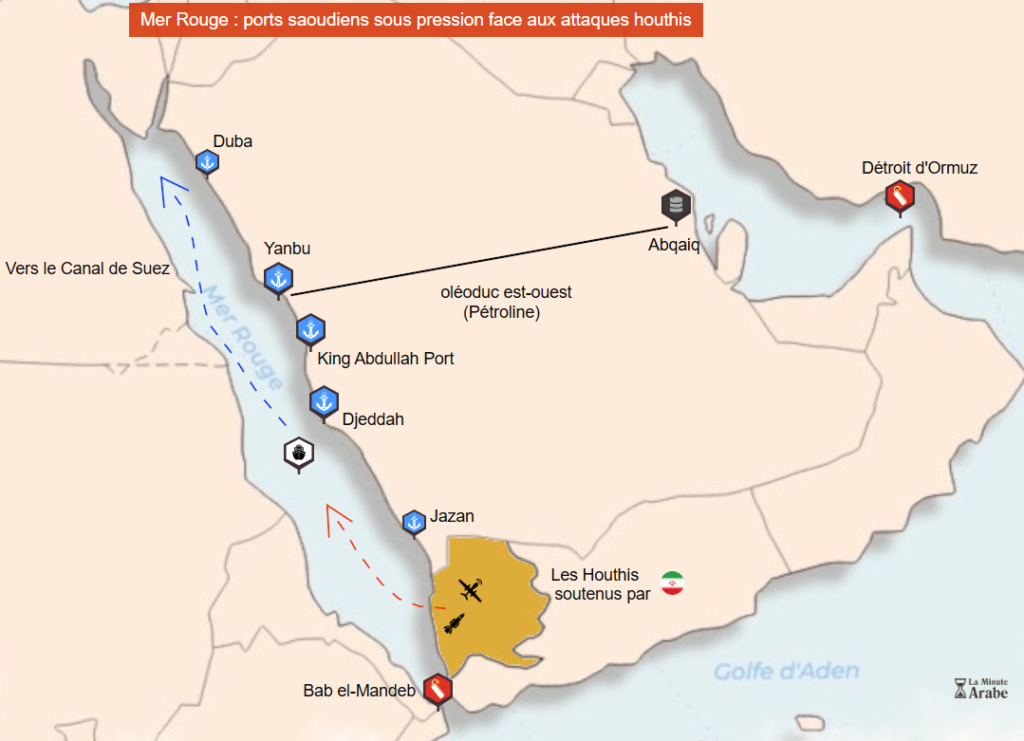
Sources: Saudi Press Agency (SPA) / Al Jazeera / AFP