

Thousands of protesters waving Kurdish flags took to the streets with a single demand: defend the Kurdistan Region’s autonomy. On Thursday, November 26, demonstrations erupted in Erbil, Duhok and Zakho against decisions made by Iraqi Prime Minister Ali al-Zaidi. Two days earlier, Baghdad had ordered federal authorities to take control of the region’s border crossings and several oil fields under Kurdish security control in the provinces of Kirkuk, Nineveh, Salahuddin and Diyala. The Khurmala oil field, near Erbil, is among the main sites potentially affected.
The stakes go far beyond an administrative dispute. Since Saddam Hussein’s forces withdrew from northern Iraq in 1991, the Kurds have gradually built their own institutions. The 2005 Iraqi Constitution formally recognised Kurdistan as an autonomous federal region, with its own government, parliament and security forces, known as the Peshmerga. Yet the division of powers between Erbil and Baghdad, particularly over oil resources and disputed territories, has never been fully resolved.
Autonomy under threat
Oil lies at the heart of this longstanding rivalry. For years, Erbil signed its own contracts with foreign energy companies and exported crude oil to Turkey, much to the frustration of the federal government. After exports were suspended in 2023, an interim agreement allowed shipments to resume in September 2025 under the supervision of Iraq’s federal oil marketing company, SOMO. Meanwhile, oil-rich Kirkuk returned to Baghdad’s control in 2017, following the independence referendum organised by Kurdish authorities.
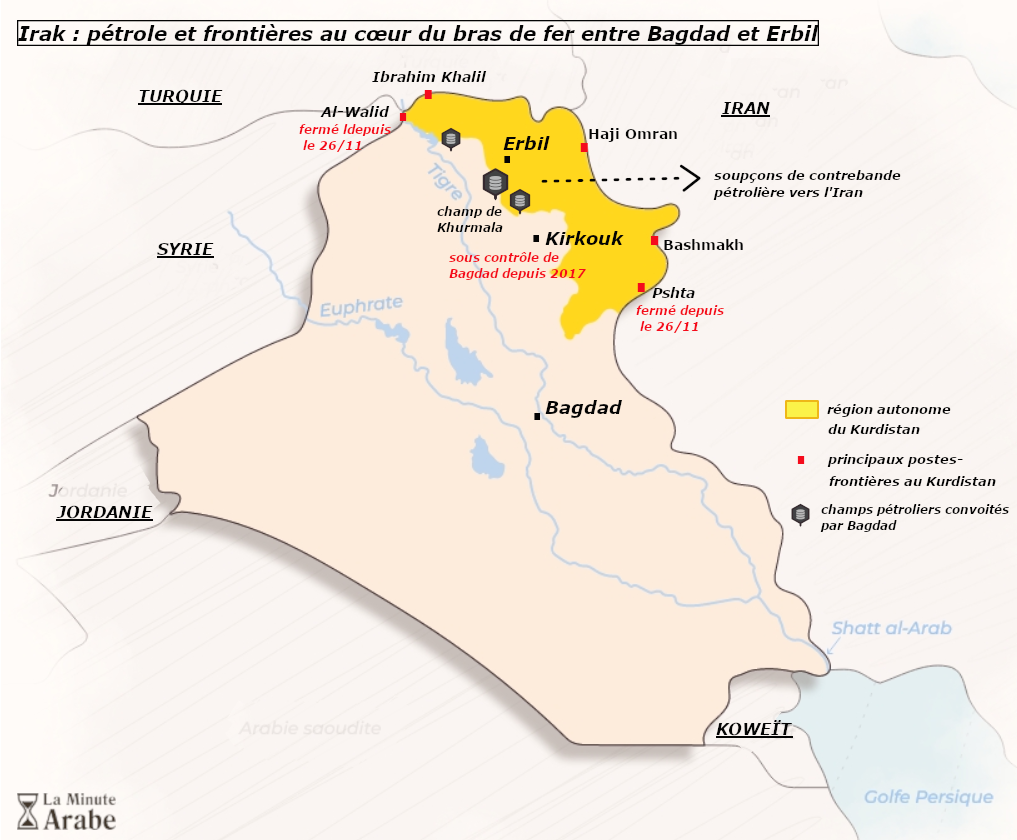
This time, the central government is citing an investigation into the alleged diversion of oil from the state-owned North Oil Company, with some of the crude reportedly smuggled into Iran. On November 20, federal forces had already deployed to Jurf al-Sakhar, a stronghold of Kataib Hezbollah, a powerful Iran-backed Shia militia, under a negotiated agreement following oil-smuggling allegations that the group denies.
On November 26, Baghdad also closed two border crossings with Syria and Iran. For Kurdish authorities, the centralisation of oil revenues and customs duties directly threatens the foundations of their autonomy. Iraq’s Federal Supreme Court has reaffirmed Baghdad’s authority over border security, although the government insists it has no intention of confronting Kurdish Peshmerga forces.
Between Baghdad’s stated crackdown on smuggling and the struggle for control over strategic resources, one question remains: how far can the federal government extend its authority without triggering another major confrontation with Erbil?