


After years of delays, the Gulf’s ambitious railway project has reached another milestone. On November 8, the six member states of the Gulf Cooperation Council (GCC) signed an agreement in Bahrain aimed at coordinating the construction and operation of the GCC Railway. First launched in 2009, the project aims to connect Kuwait, Saudi Arabia, Bahrain, Qatar, the United Arab Emirates and Oman, with the entire network now scheduled to become operational by December 2030.
The agreement sets out each country’s responsibilities, technical standards and safety requirements to ensure interoperability between national railway networks. According to GCC Secretary-General Jasem Al-Budaiwi, the project has reached 55.92% overall completion. This figure covers technical studies, land acquisition and construction, with actual railway infrastructure works significantly less advanced, at 39.61%.
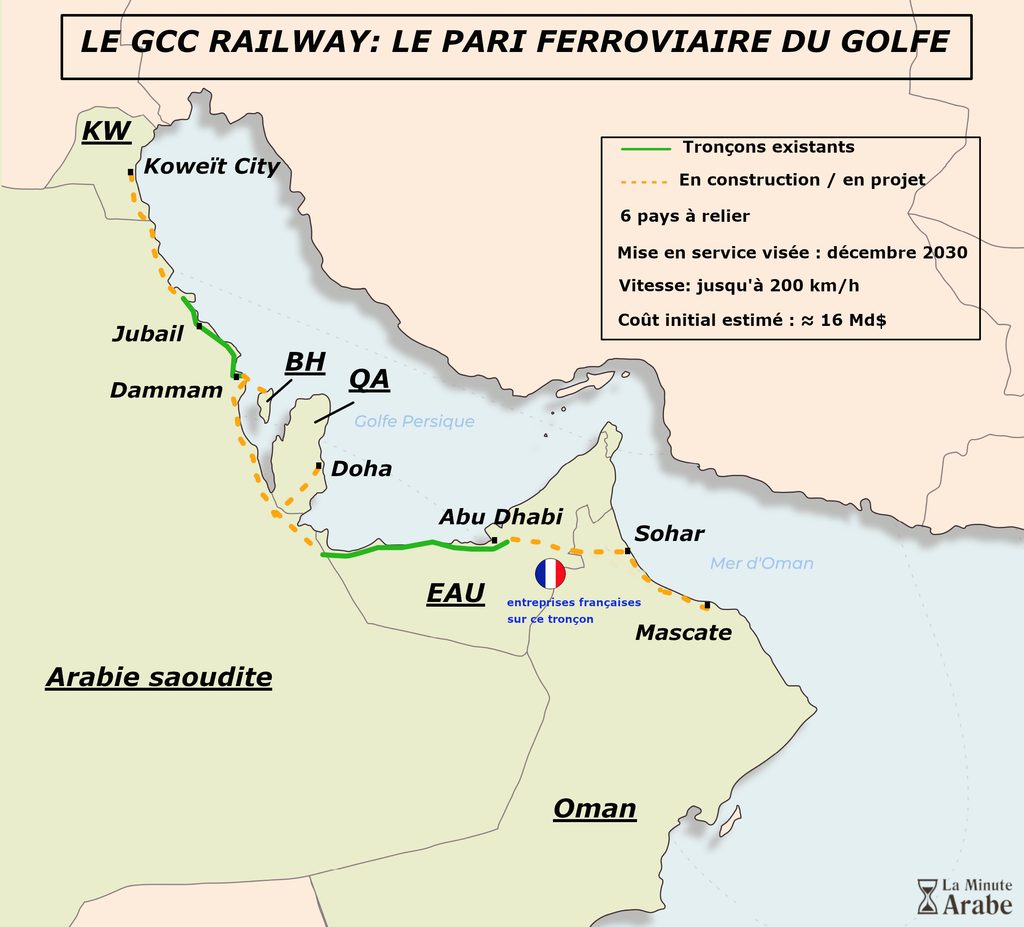
Stretching from Kuwait City to Muscat, the planned corridor will run through eastern Saudi Arabia, including Dammam, with connections to Doha and Bahrain, before continuing into the UAE and Oman. Some infrastructure is already operational, including nearly 200 kilometres of track linking Ras Al-Khair, Jubail and Dammam, as well as sections of the UAE’s Etihad Rail network, which operates 900 kilometres of freight railway lines.
200 Million Tonnes of Freight Annually
Cross-border connections now represent the project’s main challenge. Among the most advanced developments is Hafeet Rail, a 238-kilometre railway linking the UAE to the Omani port of Sohar, which was 40% complete as of April. Bahrain, meanwhile, is expected to connect to Saudi Arabia via the planned King Hamad Causeway, which will incorporate a railway alongside the road connection.
From a financial perspective, each Gulf state will be responsible for developing and funding its own section of the network. Private-sector partnerships remain an option, depending on the commercial viability of individual segments. Initially estimated to cost between $15.4 billion and $16 billion, the overall project budget is currently being reassessed amid rising material and construction costs. The first international connections could nevertheless enter service in phases, without waiting for the entire network to be completed.
The project’s ambitions are substantial. According to projections released by GCC authorities, the railway could carry six million passengers and 200 million tonnes of freight annually by 2030. Passenger trains are expected to reach speeds of up to 200 km/h, while freight trains would operate at between 80 and 120 km/h.
Beyond its economic benefits, the project has taken on greater strategic significance amid disruptions to maritime traffic through the Strait of Hormuz. By connecting ports, industrial zones and domestic markets, Gulf states aim to diversify their supply chains and reduce their reliance on road and maritime transport. Rail will not replace shipping, but it could become a vital pillar of regional economic integration.