



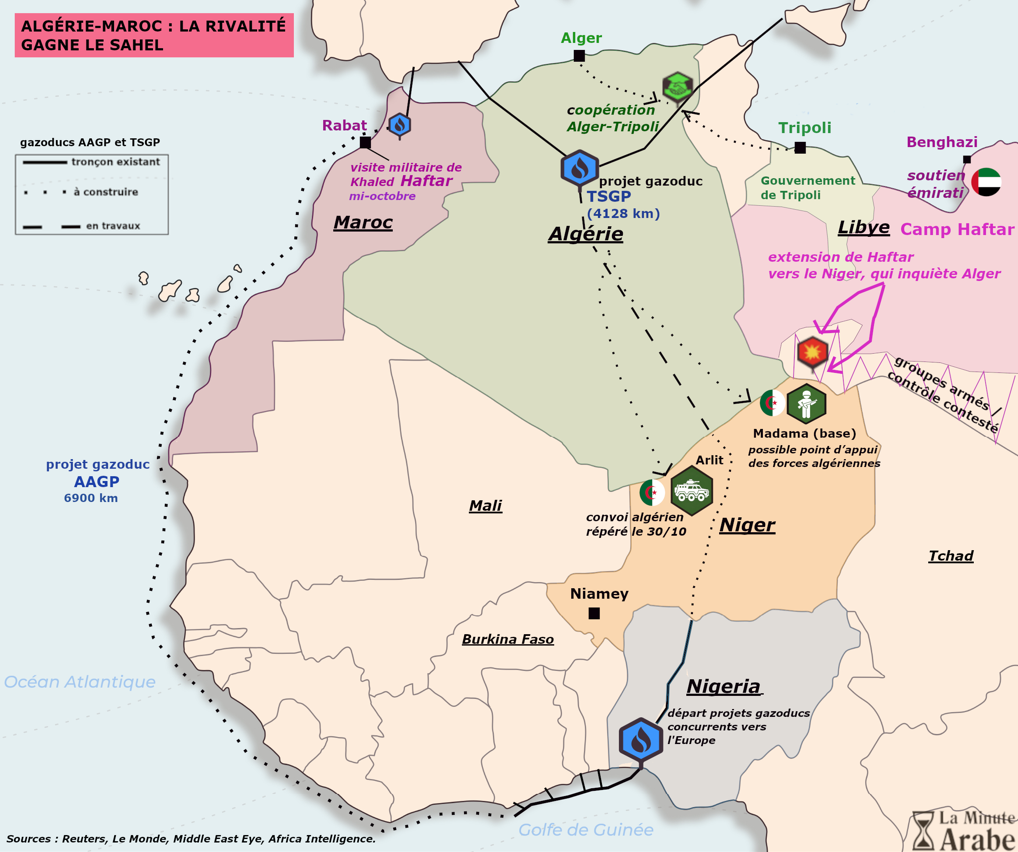
Algeria’s unprecedented troop deployment to Niger also reflects growing concerns in Algiers over the expanding influence of Morocco, the United Arab Emirates and their partners across the Sahel, according to an analysis published by Middle East Eye on Wednesday, 4 November. At the centre of these tensions are Libya’s Haftar family, ties with Israel and two competing gas pipeline projects aimed at transporting Nigerian gas to Europe.
An Algerian military convoy was spotted in Arlit, northern Niger, on 30 October, according to Reuters. The deployment, undertaken at the request of Nigerien authorities, marks a departure from Algeria’s longstanding policy of military non-intervention abroad. Officially, Algiers says its forces are there to protect shared Algerian-Nigerien economic and energy interests. But several researchers interviewed by Middle East Eye point to broader regional security concerns.
The Haftar Family at the Heart of Algeria’s Concerns
In eastern Libya, Field Marshal Khalifa Haftar commands forces that also control much of the country’s south, including areas bordering Algeria and Niger. Backed for years by the UAE, his forces have been extending their influence along desert routes connecting Libya to Niger.
This expansion has raised concerns among Algeria’s military leadership, according to Le Monde. Niger’s Madama military base, located near the Libyan border and previously used by French forces, has been identified as a potential base for Algerian troops. However, no permanent deployment there has been confirmed.
Morocco, meanwhile, has been developing closer ties with the Haftar family. From 11 to 15 October, Khaled Haftar, the field marshal’s son and chief of staff of eastern Libya’s armed forces, paid an official military visit to Rabat. His brother Belkacem, who heads Libya’s Development and Reconstruction Fund, was received by Moroccan Foreign Minister Nasser Bourita on 17 October.
These growing military and diplomatic ties come after Algeria severed diplomatic relations with Abu Dhabi on 10 September, accusing the Emirati authorities of hostile actions. The UAE has also been strengthening its partnerships with Mali, Burkina Faso and Niger, which together form the Alliance of Sahel States (AES). Morocco maintains ties with all three countries and has offered them access to the Atlantic Ocean through an initiative launched in 2023.
Israel and Competing Gas Pipelines Add to Regional Rivalries
Morocco’s and the UAE’s cooperation with Israel has also fuelled Algerian concerns. Rabat and Abu Dhabi both normalised diplomatic relations with Israel in 2020 under the Abraham Accords.
In an opinion piece published by TSA Algérie on 24 October and cited by Middle East Eye, former senior Algerian diplomat Amar Belani described growing instability in the Sahel as part of a “destabilisation strategy actively involving the United Arab Emirates, Morocco, Israel and certain French proxies”. He also warned that continued instability in Niger would “directly threaten Algerian interests” and hinder the Nigeria-Niger-Algeria trans-Saharan gas pipeline project. These accusations, however, do not establish that the countries named are acting in a coordinated operation.
Competition over energy infrastructure is adding to these tensions. Algeria is backing a pipeline that would carry Nigerian gas through Niger to Algerian territory, while Morocco is promoting a competing project running along West Africa’s Atlantic coast. According to Middle East Eye, the UAE has agreed to provide financial and technical support for the latter. Neither pipeline is yet operational.
Algeria’s rapprochement with Niger also addresses the country’s security needs. Niger continues to face attacks by jihadist groups and persistent instability following the July 2023 coup.
A recent development, however, has complicated the regional picture. On 1 November, just two days after the arrival of the Algerian military convoy, Nigerien Prime Minister Ali Mahaman Lamine Zeine travelled to Benghazi, where he met Saddam Haftar, another son of the field marshal. A memorandum of understanding on cooperation was signed with the eastern Libyan authorities.
Niger is thus strengthening military ties with Algeria while also expanding cooperation with the Haftar camp, whose advance towards Niger’s borders is itself a source of concern for Algeria’s military leadership.