

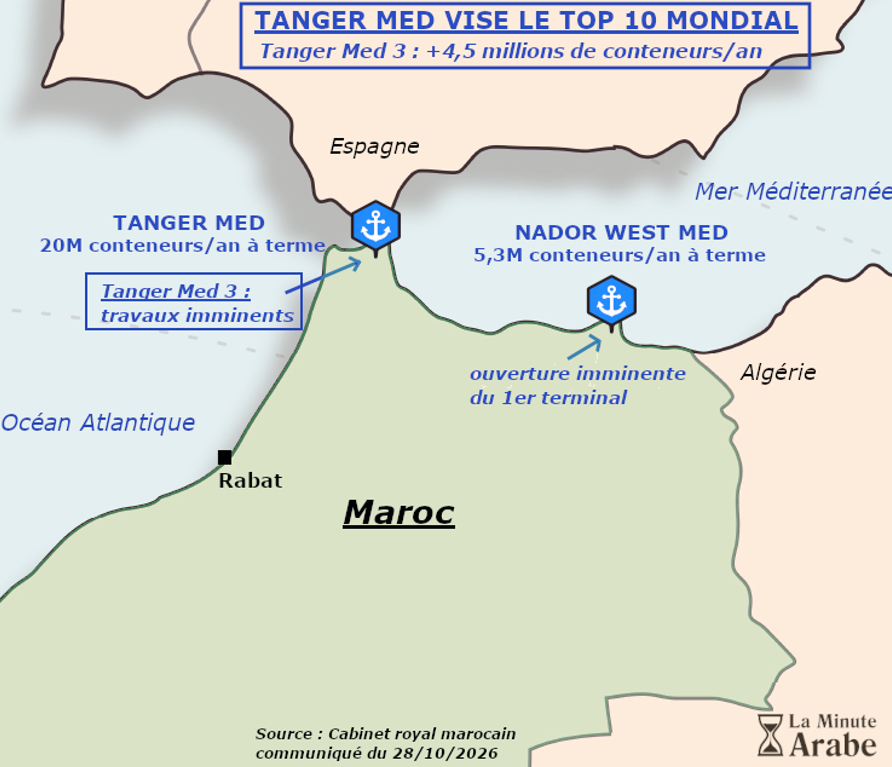
Morocco is preparing to begin construction of Tanger Med 3, a new port development that could raise the Tanger Med complex’s annual container-handling capacity to 20 million and potentially place it among the world’s ten largest container ports, according to the Royal Cabinet. The plans were reviewed on Wednesday, 28 October, at a meeting chaired by King Mohammed VI at the Royal Palace in Rabat.
Around 300 kilometres further east, the first container terminal at Nador West Med is expected to begin operations within days, with a second scheduled to follow in April 2027. The two developments are intended to expand Morocco’s maritime infrastructure while attracting industrial and energy investment to different parts of its Mediterranean coast.
Tanger Med 3: a €730 million expansion
Located west of Tanger Med 2, the new port will require an investment of 8 billion Moroccan dirhams, approximately €730 million. It will feature 1,200 metres of quays and add annual handling capacity of 4.5 million containers, according to the Royal Cabinet.
A concession agreement has already been signed with Danish shipping group Maersk, through its port-operating subsidiary APM Terminals, to develop the new container terminal. Construction is expected to begin shortly, although no opening date has been announced.
Once the planned expansions are completed, Tanger Med could reach a total annual capacity of 20 million containers. The Royal Cabinet says this could put the complex among the world’s ten largest ports. That ambition remains dependent on the completion of the projects and future traffic growth, as international port rankings generally measure containers actually handled rather than theoretical capacity.
Tanger Med is already one of the Mediterranean’s leading container ports. Its four container terminals handled 11.1 million twenty-foot equivalent units (TEUs) in 2025, an increase of 8.4% from the previous year, according to the port authority.
Nador West Med: two terminals and nearly €5 billion in investment
Near Nador, on Morocco’s Mediterranean coast, the first container terminal at the new port complex is due to begin operations within days. It is designed to reach an eventual annual capacity of 3.5 million containers.
A second terminal, with capacity for 1.8 million containers a year, is scheduled to open in April 2027. Together, the two facilities will have a planned capacity of 5.3 million containers annually. Swiss shipping group MSC and France’s CMA CGM are involved in separate terminals alongside Moroccan port operator Marsa Maroc.
Nador West Med has already secured 54 billion dirhams, nearly €5 billion, in public and private investment, according to the Royal Cabinet. The figure covers the wider port and industrial complex, not just its container terminals.
The complex also includes an industrial zone that is already operating, with one factory in production and three others under construction.
Its planned energy facilities include an oil terminal, hydrocarbon storage infrastructure and a liquefied natural gas (LNG) terminal with potential annual handling capacity of up to 5 billion cubic metres of gas. The LNG terminal is not yet operational.
Road and rail connections are also being developed, including a motorway linking the port to Guercif and a railway connection to Selouane. Moroccan authorities expect the complex to generate 14,000 direct jobs and 20,000 indirect jobs in the near term.
By developing both Tanger Med and Nador West Med, Morocco aims to spread industrial investment between Tangier and the northeastern Oriental region. The two ports also benefit from their proximity to the Strait of Gibraltar, which links the Atlantic Ocean and the Mediterranean Sea. Around 19% of global seaborne trade by volume passed through the strait in 2023, according to the OECD.
At Wednesday’s meeting, King Mohammed VI called for the projects to deliver tangible improvements to local communities. He also urged authorities to expand vocational training programmes to help young people access jobs generated by the new port and industrial facilities.