Egypt is approaching a new milestone in the construction of its first electric high-speed rail network. On August 30, Transport Minister Kamel El-Wazir inspected work on the first line, with initial trial runs without passengers scheduled for early October along part of the route.
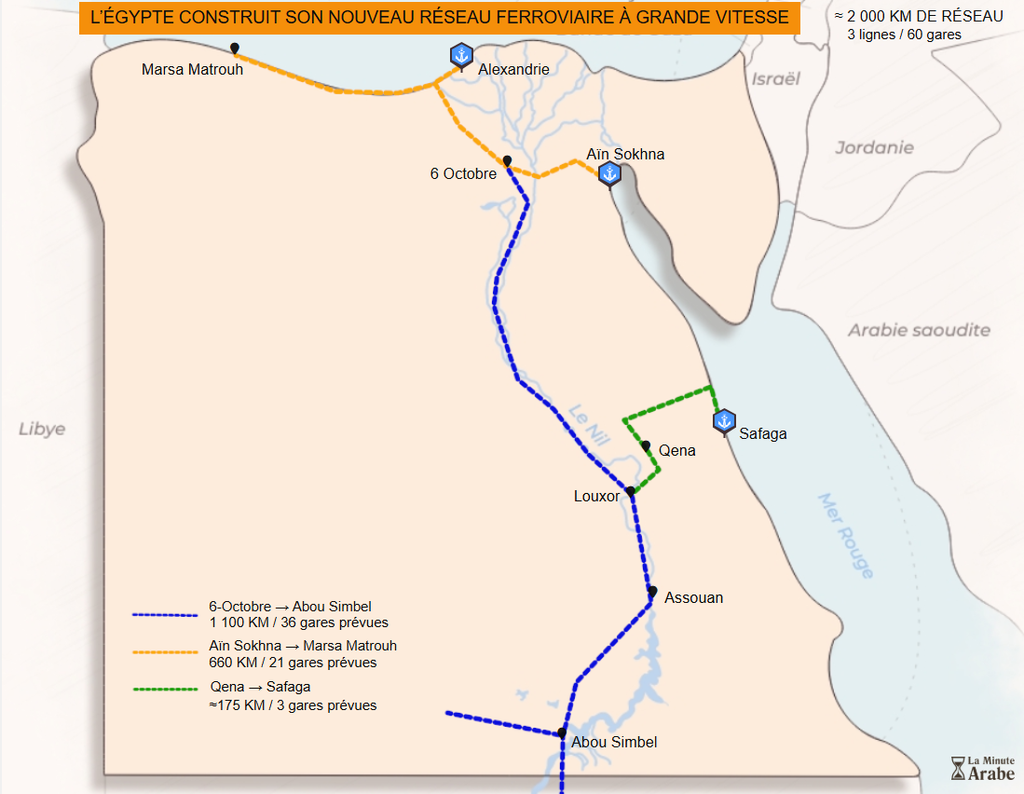
Stretching 660 km and comprising 21 stations, the first line will connect Ain Sokhna, on the Red Sea, with Marsa Matrouh, on the Mediterranean, via the New Administrative Capital, Greater Cairo, Alexandria and New Alamein. A 6-km rail link will also connect the network directly to Ain Sokhna port.
The project, however, is much broader. Egypt is building three lines spanning nearly 2,000 km and 60 stations, designed to carry both passengers and freight. The second line, extending 1,100 km, will connect 6th of October City with Abu Simbel through Upper Egypt. Construction is progressing on several sections, particularly around Luxor and Aswan.
Target: 2.5 million passengers per day
The third line will connect Qena with Safaga and Hurghada, providing Upper Egypt with a new rail link to the Red Sea. Together, the network is intended to connect ports, major cities, agricultural regions, tourist destinations and industrial zones.
The targets are ambitious. Once all three lines are operational, they are expected to carry 2.5 million passengers per day. Combined with the conventional railway network, Cairo aims to increase total rail capacity to around 4 million passengers per day by 2030, alongside 15 million tonnes of freight annually.
The technological component of the project is being delivered notably by Siemens Mobility, alongside Orascom Construction and Arab Contractors. The contract covering the three lines is worth €8.1 billion and includes 41 high-speed trains, 94 regional trains, 41 freight locomotives and 15 years of maintenance.
A Project Facing Delays
Egypt’s rail transformation is nevertheless progressing more slowly than initially planned. In an investigation published on August 30, Al-Araby Al-Jadeed reported that several major Egyptian rail projects are facing financing constraints and repeated delays.
Trial operations on the first high-speed line had initially been announced for November 2024, before being postponed several times. If trials begin in October 2026 as currently planned, they will start almost two years behind the original schedule, against a backdrop of rising construction costs, fluctuations in the Egyptian pound and the need to secure external financing.
Despite these constraints, the network remains one of Egypt’s largest infrastructure projects. With a Red Sea–Mediterranean corridor, a 1,100-km north-south axis through Upper Egypt and a connection to Safaga and Hurghada, Cairo aims to turn high-speed rail into both a mass-transit network and a major new logistics backbone for the country.