

QatarEnergy has extended until early November the suspension of five liquefied natural gas (LNG) deliveries to Edison, the Italian subsidiary of EDF, bringing the number of cancelled cargoes since April to 29, Reuters reported on Friday.
The five cargoes had been due for delivery between late September and early November. Edison, which has a 25-year supply contract with QatarEnergy, normally receives 6.4 billion cubic metres of gas a year, equivalent to roughly 10% of Italy’s annual consumption. By late July, the company had already said that 24 cargoes were affected by force majeure.
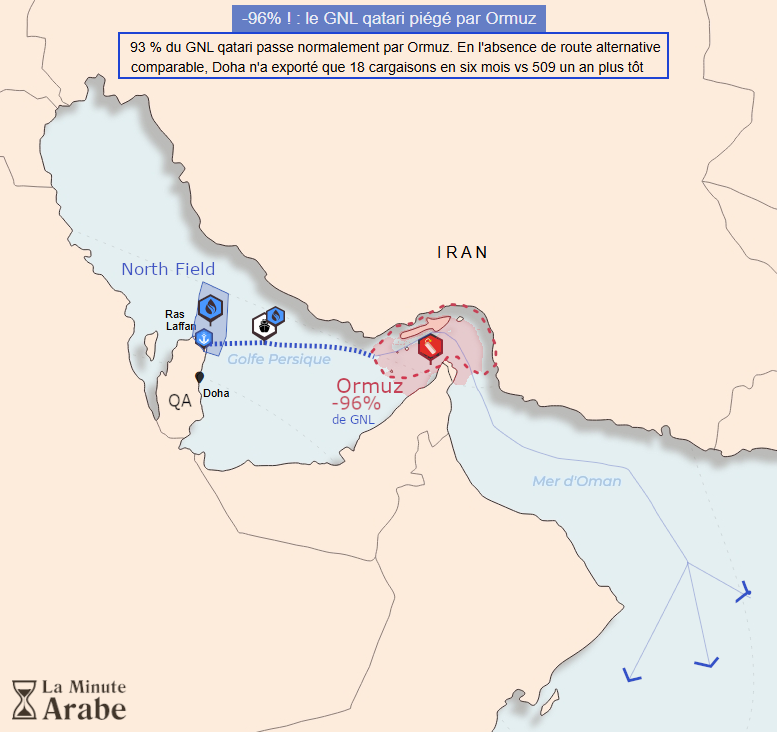
The latest extension comes as Qatar’s LNG exports have fallen by 96% over six months. Only 18 cargoes left the country during the period, compared with 509 a year earlier, according to ICIS data cited by Reuters. The resulting revenue shortfall is estimated at around $24 billion. Before the war, Qatar supplied close to 20% of global LNG.
Hormuz remains the only major outlet
Qatar produces gas from the North Field, the world’s largest non-associated gas field. Much of it is processed and liquefied at Ras Laffan on the country’s north-eastern coast, home to the world’s largest LNG export complex.
LNG carriers leaving Ras Laffan must then pass through the Strait of Hormuz to exit the Gulf. Unlike Saudi Arabia and the UAE, which can reroute part of their oil exports to terminals outside the strait, Qatar has no alternative route capable of handling its LNG export volumes.
Qatar does export some gas by pipeline to the UAE and Oman, but those regional flows cannot replace the LNG volumes shipped by tanker to Asia and Europe.
EDF subsidiary hit
Edison says it has so far replaced the missing Qatari cargoes with alternative supplies in order to meet its commitments to customers.
The drop in Qatari exports has also tightened global LNG supply. The United States has increased its LNG shipments since the start of the war, while European gas inventories remain low for the time of year.
Doha pushes for shipping to resume
With no alternative maritime route, Doha is backing diplomatic efforts to restore shipping through Hormuz. Qatari Prime Minister Mohammed bin Abdulrahman Al-Thani travelled to Tehran on Thursday, where he stressed the importance of freedom of navigation through the strait.
Talks are also under way over a temporary maritime corridor involving Iran and Oman, as well as a joint mine-clearance plan for the strait.