

Syria and Russia have signed a memorandum reducing Moscow’s control over its bases at Tartous and Hmeimim, while allowing Russia to maintain a military presence on the Syrian coast, the Syrian Foreign Ministry announced on Sunday, 9 August, according to state news agency SANA.
The agreement follows 18 months of negotiations led by the ministry and provides for the “reorganisation of the Russian presence on the Syrian coast”.
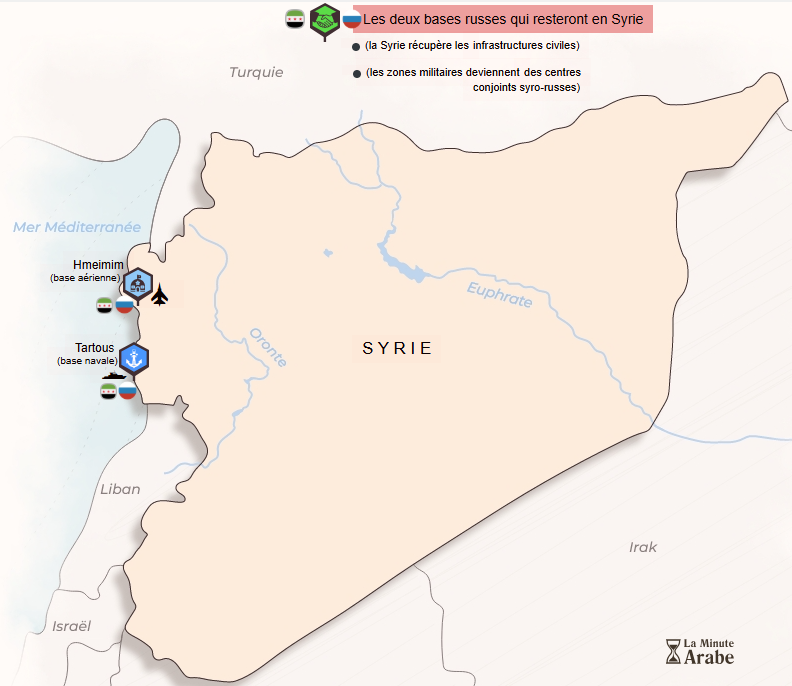
Syria will take over civilian infrastructure previously used as part of the Russian presence, including Hmeimim airport and commercial berth No. 4 at the port of Tartous, which will gradually be brought under Syrian civilian administration.
The military facilities will also be given a new role. According to the ministry, the Russian bases will be turned into “joint training and qualification centres” operated by Syria and Russia under new arrangements designed to preserve the interests of both countries. The transition must be completed within three months.
The ministry described the agreement as the “most significant step” since negotiations began, saying it opens a new phase in relations between Damascus and Moscow.
49-year agreements under Assad
The new arrangement sharply reduces the privileges Russia enjoyed under Bashar al-Assad.
In 2017, agreements governing Hmeimim and Tartous gave Russia the right to use the two facilities for 49 years, with automatic 25-year extensions unless either side chose to terminate them. At Hmeimim, a protocol extended the agreement governing the deployment of Russian aircraft, while a separate deal expanded Russia’s naval facility at Tartous.
Russia established Hmeimim as its main air base in Syria after intervening militarily in 2015 in support of Bashar al-Assad, while Tartous had hosted a Russian naval facility since the Soviet era. Moscow used both sites throughout the war against rebel groups, including forces that ultimately overthrew Assad in December 2024.
Bashar al-Assad then fled to Russia, where he still lives. Syria’s new authorities have since asked Moscow to hand him over so that he can stand trial in Syria, but the request has so far gone unanswered.
“What is useful to Syria”
Despite Moscow’s role in the war and its decision to shelter Assad, Syria’s new authorities have chosen to maintain relations with Russia.
On 29 December 2024, three weeks after Assad’s fall, Ahmad al-Sharaa, then Syria’s de facto leader, told Al Arabiya that he did not want Russia to leave the country “in a way that would not befit its relationship with Syria”. He referred to “deep strategic interests between Russia and Syria” and noted the country’s reliance on Russian equipment and expertise.
That approach has remained unchanged. In July, al-Sharaa said talks with Moscow had begun during the offensive against Assad and had already led Russian forces to withdraw from their other positions in Syria, with their presence concentrated at Hmeimim and part of Tartous.
Referring to ties between the two countries dating back to the Soviet era, the Syrian president said he wanted to “preserve what is useful to Syria and correct the course” of the relationship.
The agreement announced on Sunday now sets out the new terms of that presence: Russia will retain military facilities in Syria, but they will no longer operate as the Russian bases established under the agreements signed during the Assad era.