

Saudi Aramco posted a net profit of $32.7 billion in the second quarter of 2026, up 44% year on year, as soaring oil prices more than offset lower sales volumes, according to results released by the Saudi group on Tuesday, 4 August.
The world’s largest crude exporter had recorded a net profit of $22.7 billion a year earlier. Aramco benefited from higher prices for crude oil, refined products and petrochemicals.
Its chief executive, Amin Nasser, described the near-closure of the Strait of Hormuz as the “largest oil supply shock in history”, saying global markets had lost more than 2.6 billion barrels of supplies since the crisis began, in an interview with Al Arabiya Business.
The war against Iran, launched in late February by the United States and Israel, has sharply reduced global supplies and sent prices soaring. Traffic through the Strait of Hormuz has fallen to nearly 10% of pre-war levels, according to Nasser.
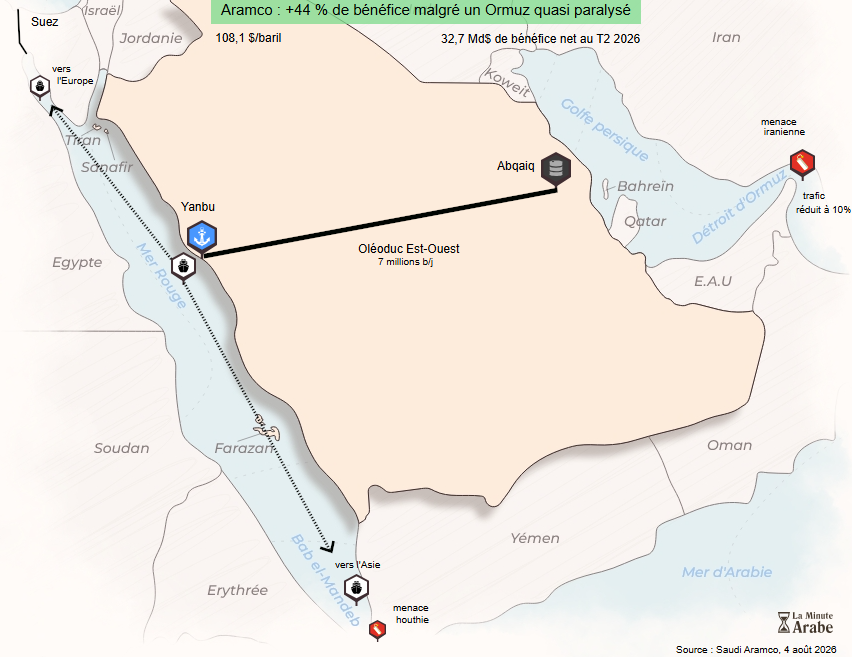
East-West pipeline provides an alternative to Hormuz
Aramco has nevertheless continued supplying its customers by rerouting some of its oil through the East-West pipeline, which links facilities in Abqaiq, in eastern Saudi Arabia, to export terminals in Yanbu on the Red Sea, bypassing Hormuz.
“Despite the unprecedented disruptions to supplies via the Strait of Hormuz, we have continued to demonstrate our ability to ensure business continuity,” Nasser said, citing “the East-West pipeline, our storage capacity and export terminals.”
The pipeline, which can carry up to seven million barrels per day, was operating at full capacity as early as the first quarter, Aramco said in May. From Yanbu, tankers can sail north through the Red Sea towards the Suez Canal and European markets, or reach the Indian Ocean via the Bab el-Mandeb Strait.
The second route remains under threat from Yemen’s Iran-aligned Houthis, who announced a maritime blockade against Saudi Arabia in July and claimed attacks on Saudi ships and energy facilities in the Red Sea.
Nasser said the strikes carried out in July had had “no significant impact” on Aramco’s production capacity. He nevertheless warned that the consequences of the oil shock extended beyond the energy sector and also threatened global food security.