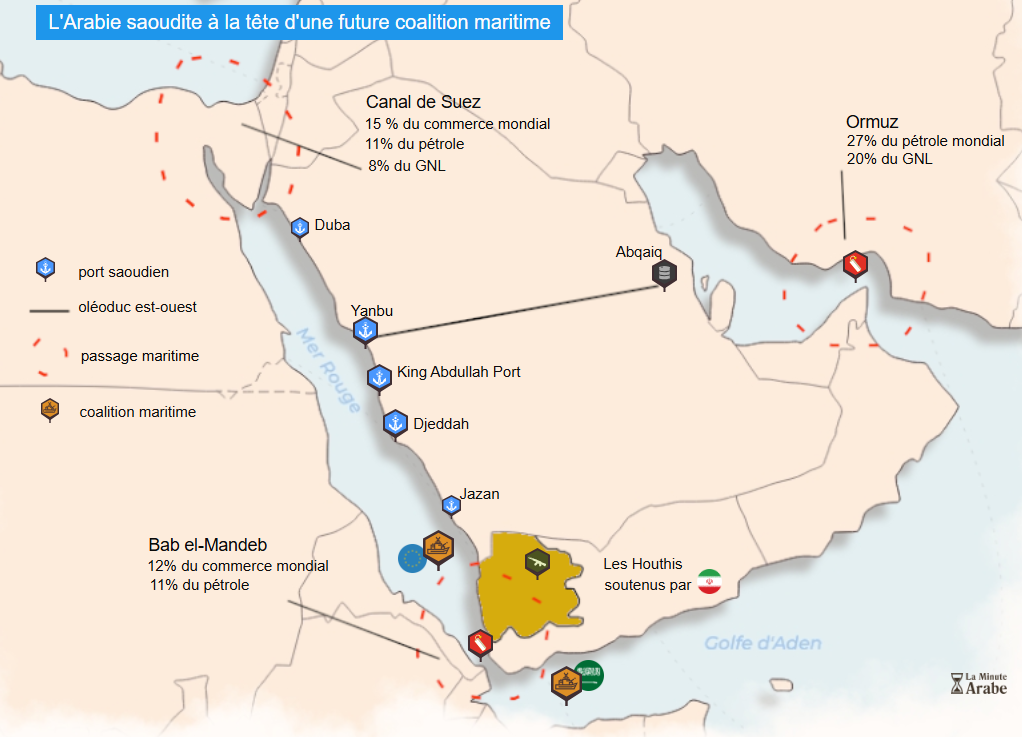
Saudi Arabia’s Ministry of Defense brought together military chiefs of staff and representatives from 43 countries in Riyadh on Thursday, July 30, to launch a naval coalition aimed at protecting navigation in the Bab el-Mandeb Strait, the Red Sea, and the Gulf of Aden. Participants agreed that Saudi Arabia would serve as the founding and leading member of the alliance and host its headquarters, according to Saudi newspaper Ajel on July 30.
The meeting focused on the draft charter, organizational structure, and command-and-control mechanisms of the future coalition. Military planners from participating countries will continue working on the framework before the agreement is formally signed and operational activities begin.
An Arab-Muslim Core
Fourteen countries signed a joint statement supporting the initiative. Alongside Saudi Arabia, they include Kuwait, Bahrain, Qatar, Egypt, Jordan, Yemen, Sudan, Djibouti, Somalia, Turkey, Pakistan, Bangladesh, and Nigeria. The absences were also significant. The United Arab Emirates was neither among the signatories nor present in the official group photo released by the Bahraini military, amid ongoing tensions between Riyadh and Abu Dhabi. Oman and Morocco appeared in the photo but did not sign the statement.
The United States and the European Union were also present at the meeting. The EU delegation to Saudi Arabia took part in the discussions, and the U.S. chairman of the Joint Chiefs of Staff appeared in the official photo, according to Al Hurra. However, neither Washington nor Brussels signed the support statement. The United States has not confirmed its participation, while Saudi Defense Minister Khalid bin Salman reportedly told the White House that Riyadh was capable of handling the Houthi threat on its own, according to Axios.
Houthi Blockade as the Trigger
The initiative comes in response to the maritime blockade announced by Yemen’s Houthis on July 20 against Saudi ports, in what the group described as a retaliatory measure. Since then, the Houthis have targeted the Saudi oil tanker NCC Ghazal with a ballistic missile and attacked Aramco facilities in Jizan. Riyadh responded with airstrikes on the port of Hodeidah.
Tensions could escalate further. According to Reuters, the Houthis are considering imposing transit fees on vessels passing through the Bab el-Mandeb Strait through a dedicated entity that would collect payments from shipping companies. Yemeni Information Minister Moammar al-Eryani described the move as an attempt to turn a strategic maritime corridor into a permanent source of revenue for the militia.
A Vital Energy Corridor
Since the closure of the Strait of Hormuz to vessels linked to the United States, the Yanbu terminal has become the kingdom’s main outlet for oil exports. The Bab el-Mandeb Strait, which narrows to 29 kilometers at its most restricted point, handled 4.1 billion barrels of crude oil and refined products in 2024 — around 5% of global flows. Traffic has since dropped sharply, falling to just 11 vessels over one weekend compared with more than 70 per day before 2023, while Brent crude prices surpassed $100 per barrel last week.
However, caution remains necessary. In January 2020, Saudi Arabia, Sudan, Djibouti, Somalia, Eritrea, Egypt, Yemen, and Jordan had already signed the founding charter of the Council of Arab and African States bordering the Red Sea and the Gulf of Aden. The members never managed to establish a joint military force, limiting cooperation to coordination and intelligence sharing. The key difference this time lies in the command structure: if the charter is signed, the future maritime security architecture of the Red Sea would be headquartered in Riyadh.