Lebanon could receive up to 500 megawatts of electricity from Cyprus, enough to provide an additional four to six hours of power a day, according to an estimate by the Electricity Regulatory Authority reported by Arabic-language Lebanese outlet Al-Modon.
Beirut and Nicosia launched a World Bank-backed pre-feasibility study on 16 July into a subsea electricity interconnector between the two countries. A joint technical committee will assess demand, available capacity and the project’s economic viability.
“The clear benefit is that we will be able to provide more electricity to the Lebanese people,” Lebanese Energy Minister Joseph Al-Saddi said. He also described the project as “a bridge to the European power system via Cyprus”.
Up to six additional hours of electricity
Daniel Jeha, a member of Lebanon’s electricity regulator, told Al-Modon that the cable could have a capacity of 500 MW, providing “four to six additional hours of electricity a day”.
He cautioned, however, that it was “a project for the future, not for tomorrow”. No cost estimate, final route or construction timetable has yet been agreed. Initial findings from the study are expected in around six months.
Lebanon has endured recurring power cuts and relied on private diesel generators for decades. Long seen as one of the clearest symbols of corruption and patronage, the electricity sector cost the state more than $40 billion between 1992 and 2018, according to the World Bank.
European connection remains incomplete
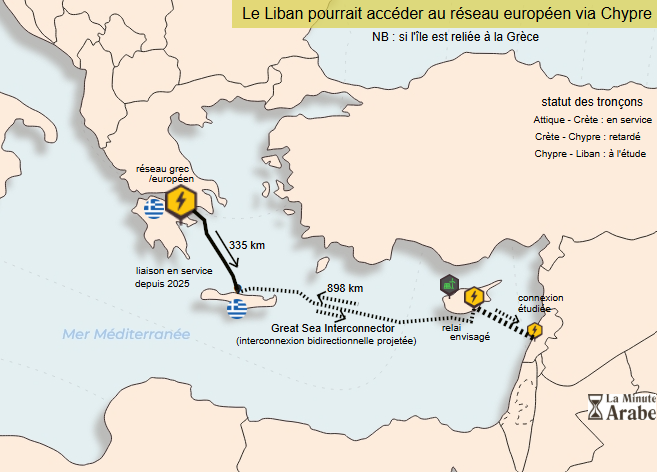
To reach the European grid, the Lebanon-Cyprus cable would rely on the Great Sea Interconnector, planned between Cyprus and Crete over roughly 898 kilometres.
The EU-backed, 1,000 MW section has yet to be built and has faced repeated delays. The 335-kilometre link between Crete and Attica, however, has been operational since 2025.
The full corridor would therefore comprise three sections: Greece-Crete, already operational; Crete-Cyprus, still planned; and Cyprus-Lebanon, now at the study stage. In time, it could offer Lebanon an alternative to the country’s private generator cartels.
See our map below: