


In Jordan, water has become a matter of national security. On November 18, construction began in Aqaba on a massive desalination and water transportation project, marking a major milestone for the Hashemite Kingdom. Worth $6.7 billion, the project will connect the Red Sea to the capital, Amman, helping address chronic water shortages exacerbated by population growth and climate change.
The challenge is twofold: turning seawater into drinking water and transporting it across the country. A desalination plant on the shores of the Gulf of Aqaba will use reverse osmosis technology to remove salt from seawater. With a capacity of 851,000 cubic metres per day, it will rank among the world’s largest desalination facilities. The water will then travel north through a 417-kilometre pipeline, supported by pumping stations capable of lifting it to an altitude of 1,100 metres. The first deliveries are expected by the end of 2030.
40% of national demand
The project is led by French investment firm Meridiam, in partnership with SUEZ, under a 30-year concession agreement. A global leader in water treatment, SUEZ will design and build the desalination plant alongside Egypt’s Orascom Construction, before operating both the facility and the pipeline network. After 26 years of operation, full ownership of the infrastructure will be transferred to the Jordanian state, under the public-private partnership agreement. A solar power plant with a capacity of around 280 megawatts is also expected to cover nearly 30% of the project’s substantial electricity needs.
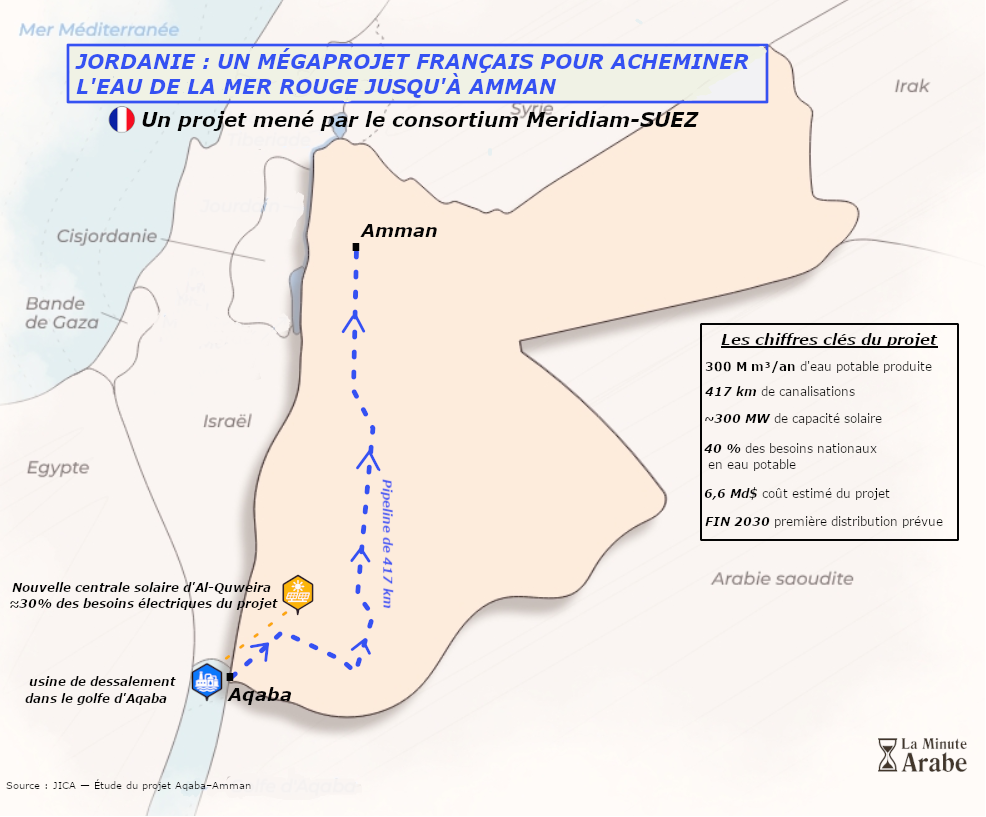
For Jordan, the benefits extend far beyond infrastructure development. With less than 100 cubic metres of freshwater available per person annually, the country ranks among the most water-scarce in the world. In many households, public water supplies are delivered just once a week, forcing residents to rely on private storage tanks. Once fully operational, the project will produce 300 million cubic metres of drinking water annually, meeting approximately 40% of national demand. Authorities hope it will increase water supply from one to three days per week in several parts of the country.
The new supply will also ease pressure on overexploited groundwater reserves and reduce Jordan’s vulnerability to drought and dependence on external water sources. It should provide greater security for households and businesses alike, although energy costs and the management of saline discharge remain significant challenges. For Amman, securing reliable access to water is no longer simply a matter of everyday convenience. It is a cornerstone of the country’s long-term stability and economic development.