


Iraq resumed oil exports through the Kirkuk–Ceyhan pipeline on Tuesday, November 17, reopening a 960-kilometre route linking the country’s northern oilfields to Türkiye and the Mediterranean. The pipeline had been shut since 2014 following attacks by Islamic State (ISIS) militants. Its return to service gives Baghdad another export outlet as the war with Iran continues to disrupt tanker traffic through the Strait of Hormuz.
Initial flows stand at 120,000 barrels per day (bpd), according to Iraqi Oil Minister Basim Mohammed Khudair. The government plans to gradually increase shipments to 500,000 bpd, although no timetable has been announced. Pumping resumed after maintenance and rehabilitation work was completed and the pipeline passed technical and operational tests.
The pipeline carries crude from the Kirkuk oil-producing region in northern Iraq to the Turkish Mediterranean port of Ceyhan. It had been out of operation since 2014, when repeated ISIS attacks damaged the infrastructure. Before the shutdown, the route carried volumes equivalent to approximately 0.5% of global oil supply, according to Reuters.
Another export route to the Mediterranean
The reopening allows Baghdad to ship crude directly through its northern federal pipeline, alongside the separate route crossing Iraq’s autonomous Kurdistan Region. Both connect to the Turkish network serving Ceyhan, but follow different routes within Iraq.
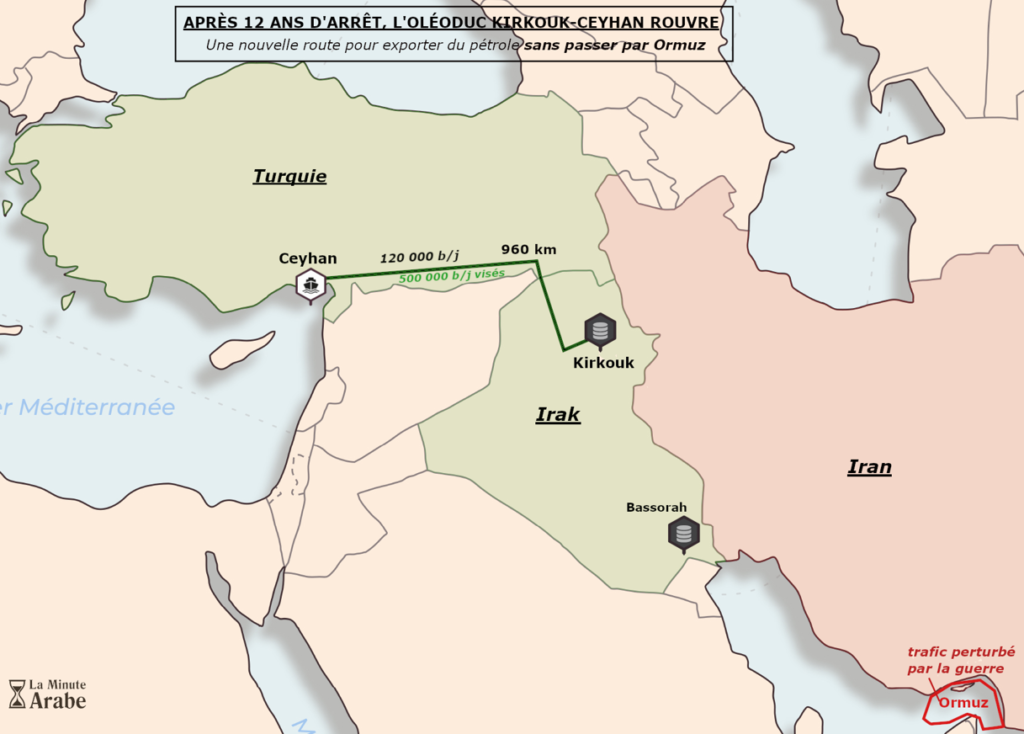
The restart comes as Iraq, OPEC’s second-largest oil producer, seeks to reduce its reliance on southern export terminals. The war with Iran has severely disrupted shipping through the Strait of Hormuz, the passage normally used by much of Iraq’s seaborne crude exports.
Iraq’s Oil Ministry also expects the restored northern route to help the country sell more crude without the price discounts associated with some alternative transport arrangements.
In August 2026, Iraq and Türkiye signed a one-year interim transport agreement providing access to the Turkish pipeline network, with capacity of up to 750,000 bpd. The arrangement was intended to keep oil moving while the two countries negotiated a longer-term agreement.
The initial restart at 120,000 bpd does not mean the pipeline has returned to full capacity. Reaching the planned 500,000 bpd will depend partly on the availability of crude. The impact on Iraq’s overall exports will also depend on how much of the oil shipped through the restored route represents additional volumes rather than supplies diverted from existing export channels.