

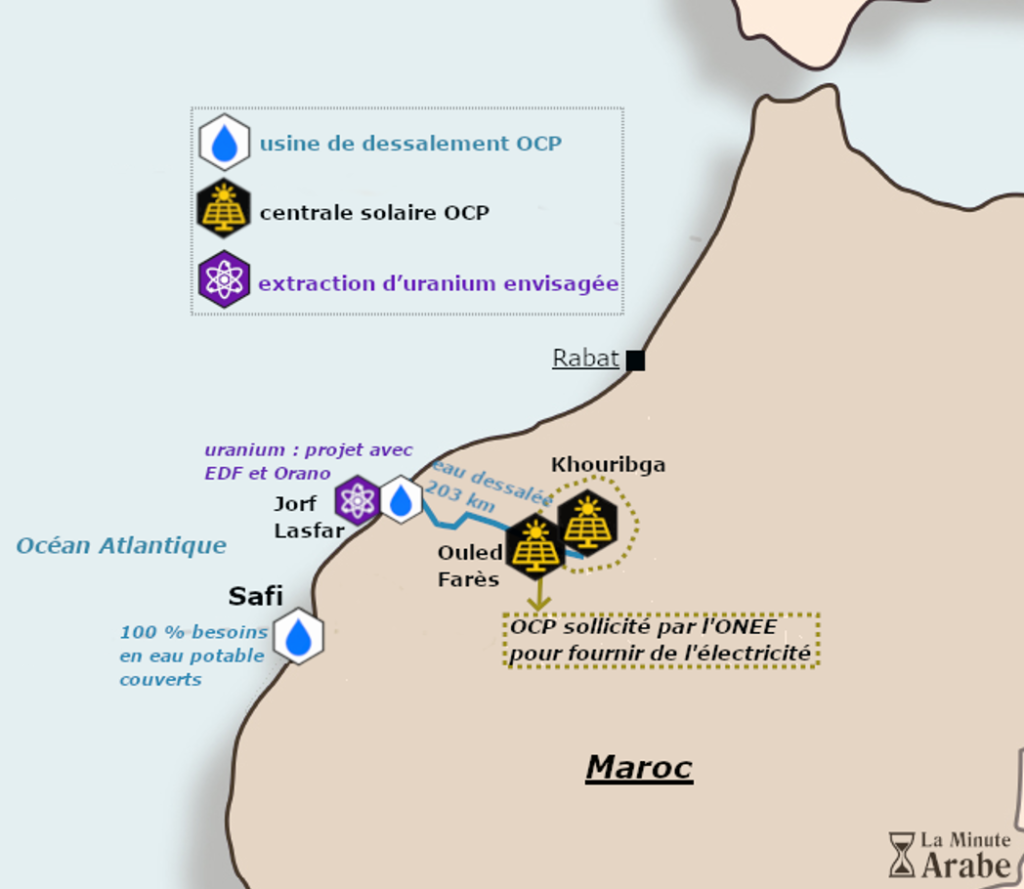
Moroccan phosphate producer OCP could begin producing uranium for France’s nuclear industry as early as 2028. The state-owned group is in talks with French companies EDF and Orano over a partnership to recover uranium naturally present in Morocco’s phosphate deposits, according to an investigation published by Le Monde on Friday, November 13. A processing plant could be built near OCP’s industrial complex at Jorf Lasfar, on Morocco’s Atlantic coast.
The proposed venture comes as OCP expands beyond its traditional fertilizer business. The group now supplies drinking water to several Moroccan cities, has agreed to help support the national electricity grid and is planning a fertilizer plant in the United States. At the same time, disruptions linked to the Middle East war are driving up its production costs and weighing on earnings.
Could Moroccan uranium power French nuclear plants?
According to Le Monde, discussions between OCP, EDF and Orano began following French President Emmanuel Macron’s visit to Morocco in October 2024. An initial agreement could be announced during King Mohammed VI’s anticipated state visit to Paris in January 2027.
Uranium occurs naturally in phosphate rock and can be recovered during phosphoric acid production, a process used in fertilizer manufacturing. OCP has reportedly conducted a successful small-scale extraction test.
The resulting uranium concentrate, known as yellowcake, could then undergo further processing before being used to manufacture nuclear fuel.
France is seeking to diversify its uranium supplies, particularly after imports from Niger stopped following the 2023 military coup.
Paris and Rabat explored a similar partnership in 2007, but the initiative never materialized. Morocco previously supplied phosphate-derived uranium to a Belgian processing facility, before production was discontinued because it was not economically viable.
No agreement has yet been signed with EDF or Orano.
OCP supplies drinking water and supports Morocco’s power grid
OCP has also expanded its role in Morocco’s water and electricity sectors.
In Safi, the group’s desalination plant has met the city’s entire drinking water demand since 2024. OCP also supplies desalinated water to El Jadida and parts of southern Casablanca.
In July 2025, its subsidiary OCP Green Water commissioned a 203-kilometre pipeline connecting Jorf Lasfar with the Khouribga phosphate-mining basin. Designed to transport up to 80 million cubic metres of desalinated water annually, it supplies mining operations while reducing their dependence on freshwater resources.
OCP has also been called upon to help Morocco’s electricity system.
According to an investigation published by Moroccan news outlet Médias24 on November 5, national utility ONEE twice asked OCP to make electricity from one of its solar farms available to the grid. The company agreed, as several Moroccan industrial sites faced power cuts and restrictions on electricity consumption.
A planned $450 million fertilizer plant in the United States
OCP has resumed fertilizer exports to the United States after the Trump administration temporarily suspended countervailing duties on Moroccan imports on June 29.
In August, a shipment of 54,000 tonnes of Moroccan phosphate fertilizer arrived at the Port of New Orleans, Louisiana.
The company is also working with CHS, a major US farmer-owned agricultural cooperative, on a fertilizer plant in Waggaman, near New Orleans.
Announced on August 26, the proposed facility would involve an investment of up to $450 million and could produce more than one million tonnes of phosphate fertilizer annually. The project remains subject to regulatory and financing approvals.
However, the US trade dispute remains unresolved. On November 3, the Department of Commerce concluded that removing the existing countervailing duties would likely lead to the continuation or recurrence of subsidies it considers unfair. A separate US trade authority has yet to complete its review of the measures.
Soaring sulfur costs hit OCP’s earnings
OCP’s expansion plans come as the company faces higher raw material costs.
Disruptions to supplies from the Middle East have pushed up sulfur prices, increasing the cost of producing phosphoric acid and phosphate fertilizers.
In the first half of 2026, OCP’s earnings before interest, taxes, depreciation and amortization (EBITDA) fell 28.5% to 13.3 billion dirhams, from 18.6 billion dirhams a year earlier. Revenue declined 7.3% to 48.4 billion dirhams.
The company said it had built up sulfur inventories and adjusted its product mix to reduce its dependence on costly raw materials. Higher fertilizer prices also weakened demand in several markets, including India, Europe and Africa.
OCP is continuing its investments in water, energy and fertilizer production, while the proposed uranium venture with France remains dependent on a formal industrial agreement.