

Algeria and Niger brought their trans-Saharan fibre-optic interconnection into service on 6 October at the In Guezzam-Assamaka border crossing, giving landlocked Niger an additional terrestrial route into Algeria’s telecom network, Niger’s communications ministry said.
The link is now “officially operational”, the ministry said after a launch ceremony in Assamaka attended by Algeria’s telecommunications minister Sid-Ali Zerrouki and Niger’s communications and information technology minister Hamani Kargné.
The connection allows the two countries’ networks to exchange internet traffic directly by fibre optic cable. For Niger, which has no coastline, it provides another route towards the international networks reached through neighbouring countries.
An additional route for Niger’s internet traffic
Internet traffic from a landlocked country must travel through terrestrial networks in neighbouring states before reaching major international connections.
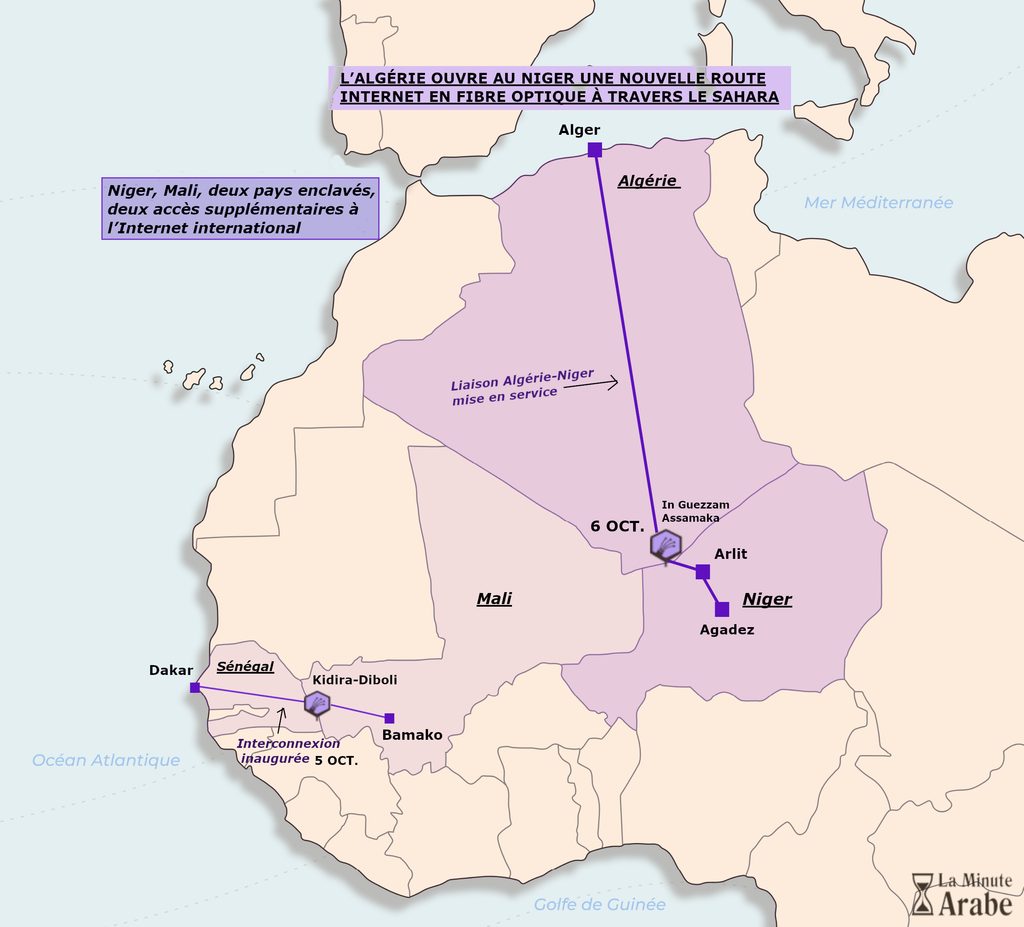
Adding more cross-border links therefore reduces reliance on a single route. If one connection is cut, congested or unavailable, some traffic can be redirected through another.
The new Algeria-Niger link forms part of the Trans-Saharan Fibre-Optic Backbone, a project designed to connect several countries across the Sahara and the Sahel through high-capacity terrestrial networks.
Algeria has for several years presented the route as a way of linking countries south of the Sahara to its own telecommunications infrastructure and onward international connections.
Second cross-border link opened in the Sahel within 48 hours
The Algeria-Niger connection went live one day after another cross-border fibre-optic link was inaugurated in West Africa.
On 5 October, Senegal and Mali inaugurated the interconnection of their national fibre-optic networks at Kidira-Diboli, on their shared border.
The link is expected to provide additional routes for digital traffic between the two countries and offer backup capacity if another connection is disrupted.
Mali, also landlocked, therefore gains another westward route through Senegal.
Within 48 hours, two landlocked Sahel countries strengthened their cross-border digital connections, with Niger adding a route north through Algeria and Mali another route west through Senegal.